



The latest business approach by AMD has virtually stripped owners of Radeon RX 7000 series graphics cards from enjoying the well-known FSR 4 additions.
The vague communication by the company, which stipulated that the company did not mention any updates to the share has in turn, placed RDNA 3 and the previous generations of devices in an unsupportive state.
Tech Lockout Exposed
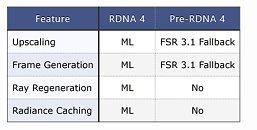
FSR 4 appears to provide an important visual experience using machine-learning up scaling on the recent RDNA 4 Radeon RX 9000 GPUs, where it has the ability to match or surpass Nvidia DLSS in terms of visual quality based on its ability to use FP8 AI instructions.
Older RDNA3 models, like the RX 7900 XTX, do not have this special hardware, and so fall back to an older and less complex FSR3.1 algorithm. However, an accidental SDK violation created an INT8 copy executable on the RX 7000 series, thus initiating a habit of fan-made updates.
Benchmarks Tell the Story
The trade-offs are pointed out by the empirical data on performance. Tests using the AMD Radeon RX 7900 XTX running Cyberpunk 2077 in 4K on Ultra settings showed that FSR 4 performed 11% faster than native but 16% slower than FSR 3.1.
It's interesting to note that AMD may be stalling these INT8 FSR 4 builds due to performance issues. However, in order to compete with Nvidia's DLSS in restoring fine details and minimizing artifacts, FSR 4 makes use of AI accelerators in RDNA 4 GPUs to improve image reconstruction.
Strategy or Stumble?
Playing an active role in selling RDNA 4 seems to be the strategic orientation of AMD in contrast to the ethos of open-source that is common with FSR. As compatible with FSR 4 and with many more titles being added, alongside the miniature device business (such with Steam Deck) needs software compatibility.
However, the fact that the company is unwilling to give a final rejection indicates that it may not be completely smooth sailing in the future.
What’s Next ?
With adequate market pressure coming into existence, a FSR4 INT8 maximization might become evident by mid-2026 and ultimately rejuvenate millions of RDNA3 setups. Without such a development, AMD can run the risk of losing a loyal customer base when Nvidia concentrates its DLSS offerings; it is necessary to keep track of driver releases to see further expansion.
Disclaimer
This article is for informational purposes only and does not constitute financial, investment, tax, or legal advice. Market data, tax rules, and prices can change after the article date. TECHi and its authors may hold positions in securities or digital assets mentioned. Always conduct your own research and consult a licensed financial, tax, or legal professional before making decisions.
About the Author

Warisha Rashid covers AI stocks and crypto markets for TECHi. Recent work explains what changed when Worldcoin cut its WLD token unlock, how AMD's rack-scale Helios design fits an asset-light strategy, and how Nvidia, Alphabet, Palantir, AMD and Broadcom compare as AI businesses.

Comments