The value of Ethereum has gone down drastically and the investors are currently in a tense position that is below the $3000 mark.
The asset was not able to retain the main psychological point, and the price dropped to a new weekly minimum of $2,790 and is currently staying at the level of $2,847 as of December 18, 2025.
Recent Price Action
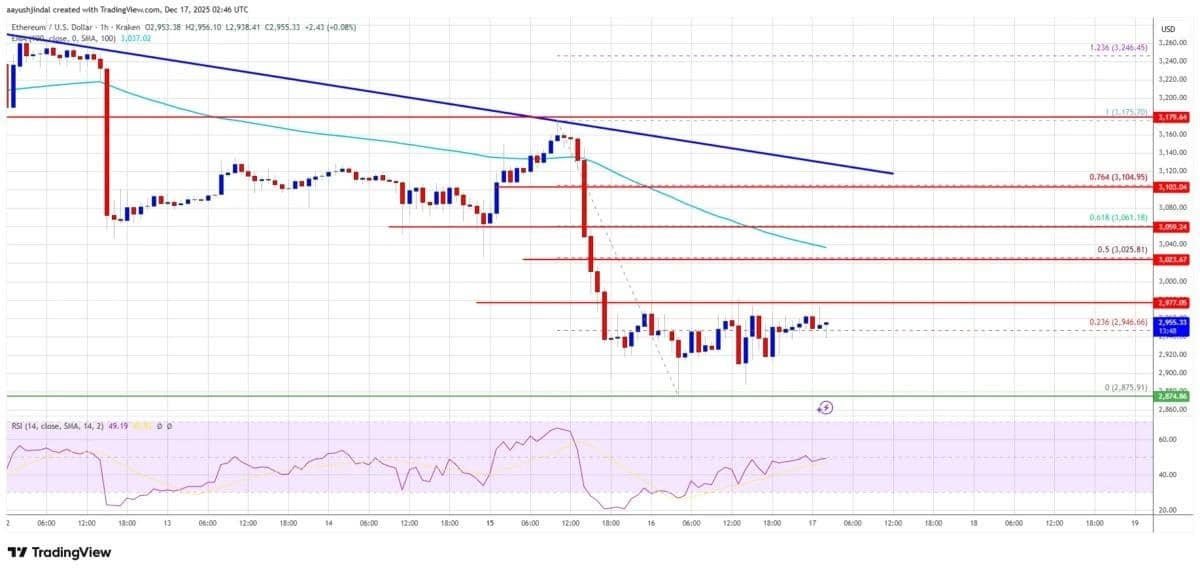
The lowering started at less than $2,950 and could cut across the 100-hour Simple Moving Average at 2,910.
The bears even pushed the price below $2,920. A low was formed at $2,875 before the slide extended to $2,790, and the price is now consolidating losses.
There was a minor recovery toward the 23.6% Fib retracement level of the downward move from the $3,175 swing high to the $2,875 low. If there is another upward move, the price could face resistance near the $2,975 level.
The next key resistance is near the $3,025 level and the 50% Fib retracement level of the downward move from the $3,175 swing high to the $2,875 low. The first major resistance is near the $3,050 level.
Price Prediction for 2026
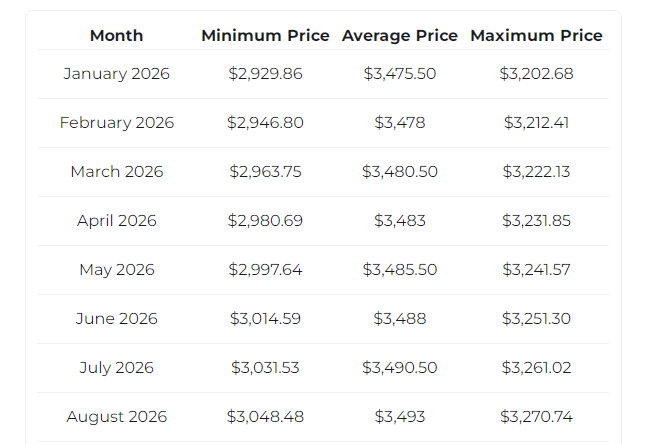
After the analysis of the prices of previous years, it is assumed that in 2026, the minimum price will be around $3,116.26.
The maximum expected ETH price may be around $3,309.63. On average, the trading price might sit between those two markers in 2026.
Future Outlook
Ethereum's recent price action has shown some key technical signals indicating it is in a retracement phase. In addition, the Relative Strength Index (RSI) is currently at 41.20, indicating a neutral market state.
This means Ethereum is neither overbought nor oversold, but is close to the lower end of the RSI range. If buying pressure increases, it could signal a price reversal.
However, if the RSI continues to decline, it may indicate that bearish momentum will persist and support levels will be tested more aggressively.
Given both Bitcoin and Ethereum ETFs are currently grappling with similar issues, the asset will only recover depending upon ETF inflows and macro sentiments.








Comments