




- Core thesisNVIDIA's AI GPU roadmap is making memory bandwidth, memory capacity and storage proximity more valuable.
- Micron's roleMicron is already shipping HBM4 designed for NVIDIA Vera Rubin and is seeing data-center memory revenue accelerate.
- Financial proofMicron's fiscal Q2 revenue reached $23.86B with non-GAAP gross margin of 74.9%, followed by Q3 guidance for roughly 81% gross margin.
- Investor lensThe opportunity is real, but after a sharp MU rally, valuation and cycle risk still matter.
- VerdictMicron is one of the cleanest public-market memory plays on NVIDIA's AI infrastructure boom.

NVIDIA’s AI GPU cycle is often described as a compute story. That is only half right. The more useful market lens is that every new NVIDIA platform needs more high-bandwidth memory, more low-power DRAM around the rack, and more high-performance storage for agentic workloads. In other words, the hotter the NVIDIA GPU roadmap gets, the more valuable the memory layer becomes.
That is why Micron is no longer just a cyclical DRAM stock reacting to PC units and smartphone inventory. It is becoming one of the clearest second-order profit pools in the AI infrastructure trade. The chart in this story is the clean version: Micron’s Cloud Memory revenue rose from $2.95 billion in fiscal Q2 2025 to $7.75 billion in fiscal Q2 2026, according to Micron’s Q2 2026 results. That is not narrative. That is AI demand moving through the income statement.
The current setup is simple: NVIDIA sells the accelerated-compute engine, but the engine is increasingly gated by memory bandwidth, memory capacity, and storage proximity. Micron sells into that hunger.
Why NVIDIA’s GPU Boom Is Becoming a Memory Boom
The jump from Hopper to Blackwell to Rubin is not just a chip-generation upgrade. It is a memory-intensity upgrade. NVIDIA’s GB200 NVL72 system page lists up to 13.4 TB of HBM3E memory and 576 TB/s of GPU memory bandwidth at the rack level. That is the clearest way to understand what happened to the AI hardware stack: performance is no longer only about the GPU die. It is about how quickly the system can keep those GPUs fed.
Rubin pushes the same direction. NVIDIA said the Rubin platform uses extreme co-design across the Vera CPU, Rubin GPU, NVLink 6, ConnectX-9, BlueField-4 and Spectrum-6 to reduce inference token cost and training GPU counts versus Blackwell. That language matters for Micron because the rack is being designed as one memory-aware AI factory, not a collection of standalone accelerators.
NVIDIA’s technical blog on the Vera Rubin POD goes even further: the POD includes 40 racks, 1,152 Rubin GPUs, nearly 20,000 NVIDIA dies, 60 exaflops and 10 PB/s of scale-up bandwidth. The point is not that every investor needs to model every rack. The point is that AI systems are being built around moving data faster and keeping larger context available. That is Micron’s neighborhood.
Micron Is Already Shipping Into The Next NVIDIA Platform
Micron has direct proof in the NVIDIA roadmap. In March, the company said its HBM4 36GB 12-high product had entered high-volume production and was designed for NVIDIA Vera Rubin. Micron said that product delivers more than 2.8 TB/s of bandwidth and more than 20% better power efficiency than its prior HBM3E generation.
That is why the stock market keeps revisiting Micron. HBM is not ordinary DRAM in a better package. It is a scarce, high-complexity component sitting next to the most valuable AI processors in the world. If NVIDIA’s customers are buying more Blackwell and Rubin-class systems, the memory bill attached to that demand becomes a direct Micron opportunity.
This is also why TECHi’s earlier Micron caution piece framed the stock as a powerful trade with real valuation risk, not a generic semiconductor rally. The demand signal is strong. The question is how much of that signal is already priced into MU after another surge.
The Revenue And Margin Evidence Is Hard To Ignore
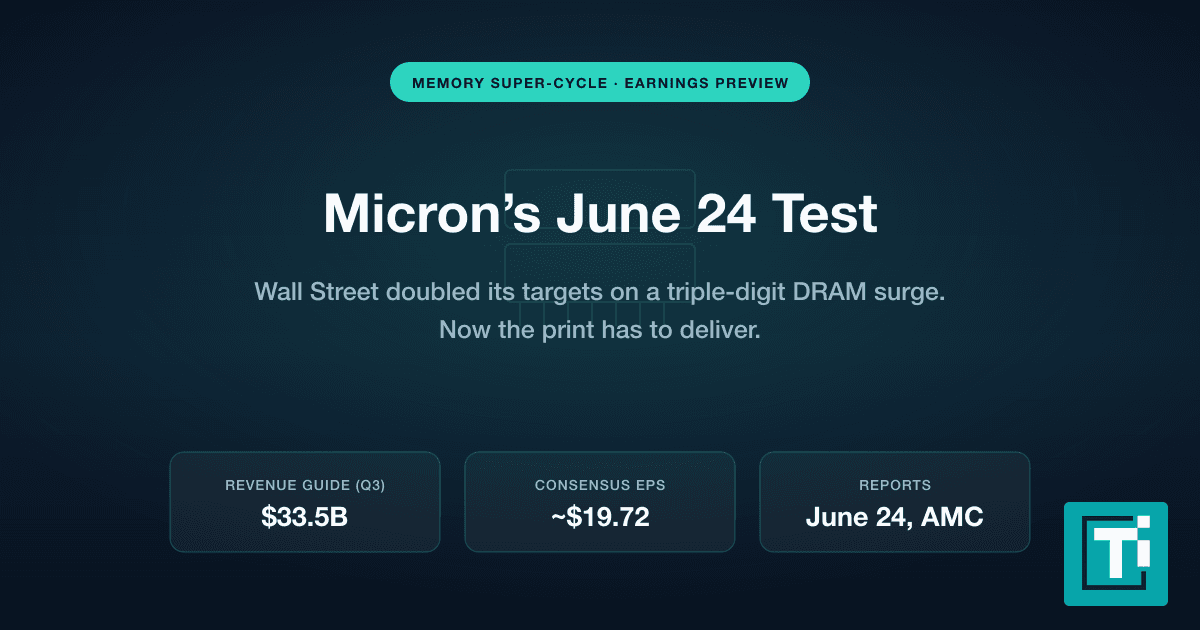
Micron’s fiscal Q2 2026 results were the kind of report memory companies rarely produce in normal cycles. Revenue was $23.86 billion, up from $13.64 billion in the prior quarter and $8.05 billion in the year-ago quarter. GAAP gross margin reached 74.4%, and non-GAAP gross margin reached 74.9%. Micron guided fiscal Q3 revenue to $33.5 billion, plus or minus $750 million, with roughly 81% gross margin.
Those margins are the story. They suggest that AI memory demand is not only lifting units. It is changing pricing power. Micron’s prepared remarks said AI demand is driving data-center DRAM and NAND bit total addressable market to exceed 50% of the industry TAM for the first time in calendar 2026, and that both AI and traditional server demand are constrained by inadequate DRAM and NAND supply. That is a very different setup from a commodity downcycle.
The prepared remarks also show why this is not just HBM. Micron said it sampled a 48GB HBM4 16-high product, giving a 33% capacity increase versus HBM4 12-high. The same document said Micron’s SOCAMM2 product enables up to 2TB of memory per CPU, and that data-center NAND demand is significantly above available supply for the foreseeable future. NVIDIA’s GPU hunger is the headline, but the profit pool spreads across HBM, LP DRAM, DDR, and SSDs.
TECHi’s NVIDIA stock analysis has focused on the size of the accelerator backlog and the Vera Rubin transition. Micron is the adjacent read-through: more AI racks mean more high-bandwidth memory, more rack memory, and more storage attached to inference and agentic workloads.
The Chart’s Message: NVIDIA’s Boom Becomes Micron’s Operating Leverage
The chart is not trying to forecast the next quarter. It is showing the mechanism. When AI accelerators move from individual GPUs to rack-scale systems, memory content expands and becomes harder to substitute. That converts GPU demand into memory operating leverage.
Micron’s Cloud Memory revenue nearly tripled year over year in fiscal Q2 2026. Core Data Center revenue also rose to $5.69 billion from $1.83 billion a year earlier. The company’s gross margin expanded because tight supply gave it pricing power, and because AI memory carries a richer mix than commodity memory.
This is why the market may keep treating Micron differently from its old-cycle identity. A normal memory bull market depends on inventory discipline and pricing recovery. This AI cycle depends on whether NVIDIA, hyperscalers and AI labs keep raising memory content per system. That is a more strategic variable.
There is a connection here to TECHi’s Sandisk, Micron, AMD and AAOI risk analysis. The market is rewarding the parts of the AI supply chain that were previously treated as lower-quality cyclicals. That can create excellent returns, but it also means the stocks become vulnerable when investors start questioning the durability of AI capex.
What Investors Should Watch Next
The first metric is HBM mix. If HBM becomes a larger share of Micron’s DRAM revenue, the company should keep earning a better margin profile than investors historically assigned to memory. The second metric is strategic customer agreements. Micron said it is working with customers on multi-year strategic customer agreements that are different from prior long-term agreements and provide more visibility. That is important because investors usually discount memory earnings when they think the cycle can reverse quickly.
The third metric is NVIDIA platform timing. Rubin and Vera Rubin are the bridges between today’s Blackwell demand and the next wave of agentic AI infrastructure. NVIDIA said first cloud providers expected to deploy Vera Rubin-based instances in 2026 include AWS, Google Cloud, Microsoft and OCI. That customer list helps explain why memory suppliers are talking about tight supply beyond a normal product cycle.
The fourth metric is substitution and competition. Micron is not alone. SK hynix and Samsung remain central to the HBM market, and NVIDIA will keep multi-sourcing where possible. Micron’s opportunity is large, but it is not guaranteed monopoly economics. The more HBM becomes a strategic bottleneck, the harder all three suppliers will fight for share.
That also makes TECHi’s TSMC stock outlook relevant. AI infrastructure profit pools are spreading across the stack: TSMC in advanced manufacturing, NVIDIA in accelerator systems, Micron in memory, Broadcom and Marvell in networking/custom silicon, and power/grid names in data-center infrastructure.
The Risk: Memory Still Has Cycle DNA
The bullish case is powerful because Micron is supplying a scarce input into a growing AI system architecture. The risk is that memory remains a brutal business when supply catches up, customers pause orders, or AI capex expectations are revised lower.
A second risk is valuation psychology. The market can be right about Micron’s strategic importance and still overpay for a vertical stock move. At Friday’s close, TECHi’s quote endpoint showed MU at $746.81, up 15.52%, while NVDA closed at $215.20, up 1.75%, both as of May 8, 2026 at 4:00 p.m. ET. When the supplier rallies much harder than the platform company, investors need to ask whether the marginal buyer is underwriting earnings or chasing the purest expression of the memory shortage.
A third risk is customer concentration. If a meaningful part of the thesis depends on NVIDIA platform timing, any delay in Rubin deployments, qualification schedules, or hyperscaler purchasing cadence can hit sentiment quickly. That does not break the structural memory argument. It does make the stock sensitive to every signal from NVIDIA’s roadmap.
TECHi Verdict
The clean takeaway is that NVIDIA’s AI GPU boom is no longer only an NVIDIA story. It is a memory story, a storage story and a rack-architecture story. Micron is one of the few public-market ways to own that pressure point directly.
The chart says what the market is starting to believe: NVIDIA keeps making AI systems bigger, faster and more memory-dependent; Micron sells the memory that lets those systems work. That is a huge profit opportunity if AI capex remains strong and HBM supply stays tight.
The right stance is bullish on the structural thesis but disciplined on entry price. Micron is feeding NVIDIA’s memory hunger, and the financials show that the meal is already profitable. The next test is whether investors can separate a real multi-year memory upgrade cycle from a stock that may already be discounting a lot of perfection.
FAQ
Frequently asked questions
Why does NVIDIA's AI GPU boom help Micron?
NVIDIA's newer AI platforms need more high-bandwidth memory, rack memory and fast storage. Micron supplies HBM, DRAM and SSD products that support those AI systems.
Is Micron already shipping memory for NVIDIA Vera Rubin?
Micron said its HBM4 36GB 12-high product entered high-volume production in calendar Q1 2026 and is designed for NVIDIA Vera Rubin.
What did Micron report in fiscal Q2 2026?
Micron reported revenue of $23.86 billion, GAAP EPS of $12.07 and non-GAAP gross margin of 74.9%, with guidance for roughly 81% gross margin in fiscal Q3.
What is the biggest risk to MU stock after the AI memory rally?
The biggest risks are valuation, memory-cycle reversal, competition from SK hynix and Samsung, and any slowdown in AI infrastructure capex or NVIDIA platform timing.
Is Micron a better AI stock than NVIDIA?
Micron is a more direct memory-supply play, while NVIDIA remains the dominant AI accelerator platform. The better stock depends on price, risk tolerance and whether memory margins stay structurally higher.
Disclaimer
This article is for informational purposes only and does not constitute financial, investment, tax, or legal advice. Market data, tax rules, and prices can change after the article date. TECHi and its authors may hold positions in securities or digital assets mentioned. Always conduct your own research and consult a licensed financial, tax, or legal professional before making decisions.
About the Author

Hazel Kaya writes about semiconductor and AI-infrastructure stocks for TECHi. Her articles have examined whether Aehr Test Systems can turn record bookings into revenue, the $2.1 billion construction bill behind CleanSpark's AI data-center lease and the credit exposure building inside Dell's AI-server boom.


Comments