



One example of such stock-related gains was related to Micron Technology, whose pre-market trading had surged by 9% on December 18, 2025, after the company announced earnings exceeding those projected by analysts.
Micron competes in a high-bandwidth memory (HBM) market that is one of the drivers of the artificial intelligence boom, but it is an underserved market, and Micron is one of only three major companies in an oligopoly that controls supply.
Profit Surge Fuels Rally
Micron reported a quarterly net profit close to two times the consensus estimate, a figure that is partially attributable to the growth in the prices of chips and the increasing data demands of the data centers.
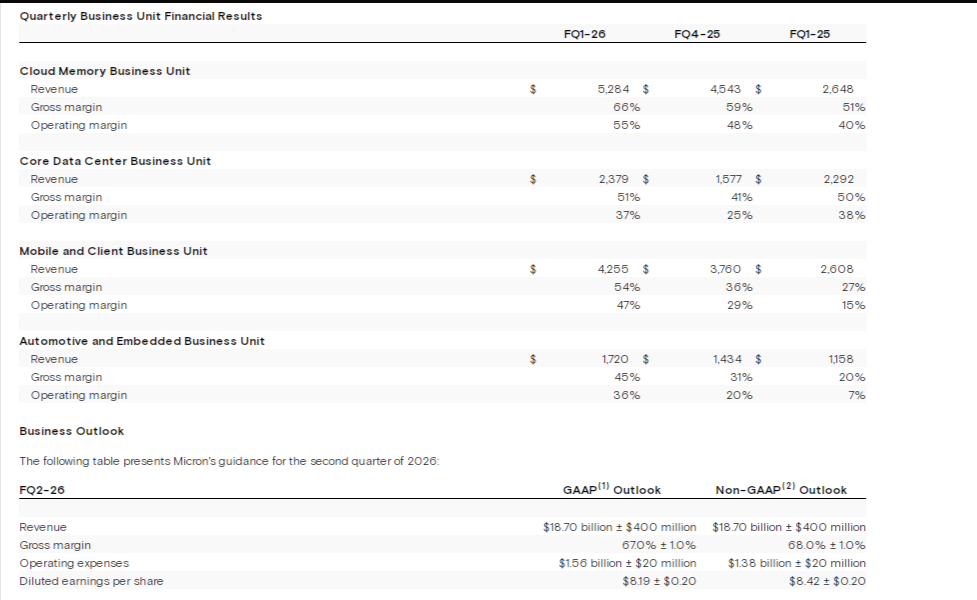
Micron said it expected about $18.70 billion of revenue in the current quarter, versus $14.20 billion expected by LSEG.
It said adjusted earnings per share would be about $8.42, blowing away expectations of $4.78 per share.
For the first quarter of 2026, investments in capital expenditures, net were $4.5 billion and adjusted free cash flow was $3.9 billion.
Micron ended the year with cash, marketable investments, and restricted cash of $12.0 billion.
On December 17, 2025, Micron’s Board of Directors declared a quarterly dividend of $0.115 per share, payable in cash on January 14, 2026, to shareholders of record as of the close of business on December 29, 2025.
During the earnings call, the CEO Sanjay Mehrotra warned that the memory markets will remain constrained beyond 2026 and that at the same time, Micron will only satisfy half to two-thirds of the demand of key customers.
According to the J.P.Morgan analyst,
"With supply tightness at unprecedented levels, MU is having to strike a fine balance between allocating wafer capacity to high-value bits while also providing adequate supply of less value-added bits to key strategic customers,"
Make AI Domination the Next Strategic Pivot
What the firm has done in the recent past is not an act of chance. Micron abandoned its Crucial consumer brand earlier this month and has committed roughly $20 billion of 2026 capital spending toward AI-focused fabrication plants.
At a forward price-to-earnings ratio of 10.81, Micron is valued higher than SK Hynix (7.21) and Samsung (9.62) which shows that the market anticipates sustainable pricing power in case of global shortage.
Bright Horizon Ahead
It is expected to keep growing and J.P. Morgan believes that other capacity will be quickly recaptured by hyperscale operators.
The demand for AI training has already grown,
"AI-related demand remains the biggest driver for Micron,"
Summit Insights analyst Kinngai Chan said
"It not only drives better margin for the company, but also helps non-AI product margins as it prioritizes its supply towards AI-related demand."
In case of market tightness, then Micron would be prone to structure its status as the leader in the provision of AI memory, outmuscling their rivals in this trillion-dollar competition.
Disclaimer
This article is for informational purposes only and does not constitute financial, investment, tax, or legal advice. Market data, tax rules, and prices can change after the article date. TECHi and its authors may hold positions in securities or digital assets mentioned. Always conduct your own research and consult a licensed financial, tax, or legal professional before making decisions.
About the Author

Warisha Rashid covers AI stocks and crypto markets for TECHi. Recent work explains what changed when Worldcoin cut its WLD token unlock, how AMD's rack-scale Helios design fits an asset-light strategy, and how Nvidia, Alphabet, Palantir, AMD and Broadcom compare as AI businesses.


Comments