
The share price of Netflix dropped 38% since its peak of June 2025 and is trading at $96.05 on February 27, following a volatile intraday change of 13.5%.
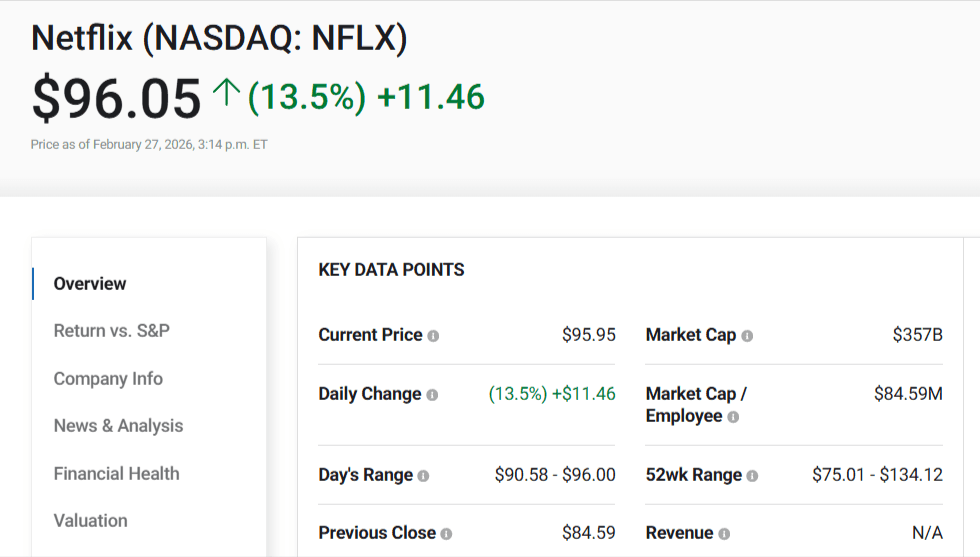
The streaming giant, with its market capitalization of $357 billion and price-to-earnings ratio being reduced by 62.5 to 32.7, finds itself in a crucial fate in the midst of a heated bidding battle against the acquisition of Warner Bros. Discovery (WBD).
Stock Slide Unpacked
The slide began in July 2025 with a 13% drop as investors questioned stretched valuations. It was escalated when Netflix offered WBD 27.75 per share in its film and streaming properties, after the Discovery cable spinoff.
Paramount Skydance (PSKY) retaliated with a $31 a share offer on the whole business, subsequently, triggering shareholder battle plans, with Warner Bros. Discovery shareholders scheduled to vote on the Netflix merger on March 20.
Paradoxically, the price of NFLX improved last week as their optimistic prospects became less, indicating that investors are not confident with a debt-driven victory.
Warner Bros. Battleground
This situation may improve the Netflix content assets or give the company billions of dollars of debt requirements. A collapse would attract a $2.8 billion breakup fee. Gross margins sit near 48.6%, with volatility running very high.
Bright Horizon Ahead
The effort to get rid of the extraneous noise is also similar to the case of Netflix rebounding after the Qwikster that actually texted a setback that strengthened its stronger performance in the long-term sustainability.
In the event of failure of acquisition, there will be an appreciation of the resultant transparency among market players, but in the event of success, the synergies might elevate profits.
At present, the stock presents a positive multi-year growth, and the March vote is the near-term catalyst for investors watching the streaming industry as it revitalizes Hollywood which may outperform the overall S&P 500 index.

Disclaimer
This article is for informational purposes only and does not constitute financial, investment, tax, or legal advice. Market data, tax rules, and prices can change after the article date. TECHi and its authors may hold positions in securities or digital assets mentioned. Always conduct your own research and consult a licensed financial, tax, or legal professional before making decisions.
About the Author
Warisha RashidWarisha Rashid writes about public companies, AI infrastructure and cryptocurrency markets for TECHi. Her portfolio includes stock comparisons, semiconductor businesses, quantum computing and crypto-token events. Her reporting also follows how technology regulation and geopolitical developments affect companies and markets.




Comments