

Updated July 13, 2026: This guide now reflects OpenAI's confidential S-1 submission, SoftBank's July 1 funding tranche, and disclosed capital-conversion mechanics. No public prospectus or listing date has been announced.
OpenAI has crossed an important line on the road to becoming a public company. It has submitted a confidential draft S-1 to the Securities and Exchange Commission.
That does not mean OpenAI stock is about to begin trading. It means the company has moved beyond informal preparation and entered a formal SEC review process. OpenAI itself says it has not decided when to go public and that a listing may still be a while away.
The better investor question has changed. It is no longer simply whether OpenAI will file. It is what a public shareholder would own after preferred securities convert, capital commitments are satisfied, voting rights are allocated, and the company's financial statements face public scrutiny.
The eventual stock would not be a simple claim on ChatGPT's growth. It would carry the economics and constraints of one of the most unusually financed and governed technology companies ever brought toward public markets.
- Filing statusOpenAI submitted a confidential draft S-1 on June 8; no public prospectus is available yet.
- TimingNo IPO date, ticker, exchange, price range, share count, offering size, or underwriters are official.
- ValuationThe disclosed $852 billion figure is a private post-money valuation, not a public market capitalization.
- Capital mechanicsAmazon and SoftBank disclosures connect a future listing to large commitments and preferred-to-common conversion.
- ControlThe OpenAI Foundation retains special governance rights, including appointment of the Group board.
- Retail accessDirect OpenAI shares remain unavailable through ordinary brokerage accounts while the company is private.
OpenAI filed confidentially, but it has not launched an IPO
In its June 8 announcement, OpenAI said it had recently submitted a confidential draft S-1. The company added an unusually direct qualification: it has not decided on timing, and there are things it may prefer to complete while remaining private.
That language should override claims that an OpenAI IPO is scheduled for a particular month or quarter. A confidential submission gives the company the option to proceed. It does not force management to set a roadshow, publish a price range, or sell shares.
As of July 14, there is no public OpenAI prospectus from which investors can verify audited financials, proposed stock classes, dilution, offering size, or insider-selling arrangements. There is also no official ticker, exchange, underwriting syndicate, or $1 trillion offering valuation.
The company's status is therefore more advanced than "considering an IPO," but less advanced than "coming to market." That makes OpenAI different from issuers already appearing on a verified IPO calendar with proposed dates or price ranges.
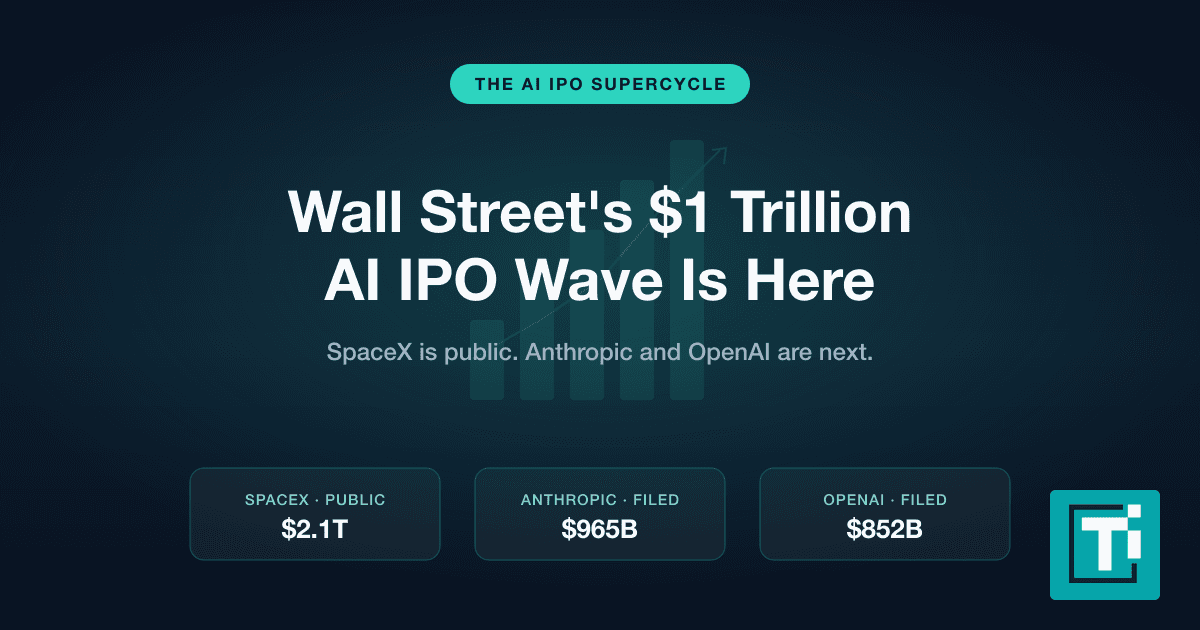
TECHi's broader AI IPO supercycle analysis provides useful industry context. OpenAI's offering, however, must be judged on its specific economics and ownership structure rather than on enthusiasm surrounding other technology listings.
What a confidential S-1 does — and does not — reveal
The confidential process allows SEC staff to review a draft registration statement before it becomes visible to investors. The company can respond to comments and revise its disclosures without conducting those exchanges in public.
It is not a hidden, completed prospectus. According to the SEC's draft-registration guidance, an IPO issuer using this process must publicly file its registration statement and prior draft submissions at least 15 days before a roadshow, or at least 15 days before effectiveness if there is no roadshow.
The first public S-1 will be the next decisive document. It should turn several private-company claims into figures investors can compare across reporting periods. It should also expose risks that a funding announcement has little reason to emphasize.
Even then, the deal will not be final. An issuer can amend its registration statement repeatedly. Price ranges, share counts, selling-stockholder participation, exchange selection, and timing may change as SEC review and the underwriting process continue. The company can also delay or withdraw.
OpenAI's Rule 135 announcement was explicit that it was not an offer to sell securities. Until a registration statement becomes effective and an offering is priced, there is no public OpenAI stock transaction for ordinary investors to evaluate.
The $852 billion valuation now faces public-market math
OpenAI said on March 31 that it had closed a financing with $122 billion in committed capital at an $852 billion post-money valuation. "Committed" matters: the figure should not be treated as $122 billion received in cash on a single day. The company also reported that it was generating $2 billion in monthly revenue.
Annualizing one month's revenue produces a $24 billion run rate. Dividing the private post-money valuation by that figure gives a simple multiple of about 35.5 times annualized revenue.
That calculation is a reference point, not a full valuation. The $2 billion figure is company-reported and does not establish that the month was representative. It is not trailing audited revenue. It says nothing by itself about gross margin, operating losses, cash consumption, stock-based compensation, or the cost of contracted compute capacity.
Fortune reported that copies of audited 2025 statements showed $13.07 billion of revenue and a $20.92 billion operating loss. Those figures were reported from leaked statements; they have not appeared in an OpenAI public SEC filing. On that reported revenue, the $852 billion private valuation equals roughly 65 times 2025 sales. The public S-1 must confirm or correct the underlying numbers.
OpenAI also reported more than 900 million weekly users, over 50 million subscribers, and an enterprise business contributing more than 40% of revenue. Those numbers describe enormous distribution. Public investors still need to learn how efficiently that demand becomes durable cash flow.
The S-1 should show whether revenue is becoming more predictable as enterprise usage expands, how much model serving costs at scale, and how heavily OpenAI must spend to remain near the frontier. It should also separate cash already received from future funding subject to conditions.
A public valuation cannot be underwritten from user growth alone. At $852 billion, relatively small changes in assumed margins, capital intensity, or long-term growth can move the implied equity value by tens or hundreds of billions of dollars.
The IPO is also a capital-conversion event
OpenAI's financing arrangements make the prospective listing more complicated than a conventional transition from private common shares to public common shares.
An Amazon investment agreement filed with the SEC identifies an exact $34,999,999,447.98 remaining commitment after an initial preferred-stock purchase. The agreement says OpenAI must give Amazon a listing notice after a confidential submission and no later than six weeks before an anticipated listing. It also provides that closings after a listing would issue common stock instead of preferred stock.
The agreement contains redacted conditions, so it should not be read as proof of every event that could trigger the remaining investment. What it does establish is that a public S-1 and listing mechanics can affect the timing and form of a very large capital commitment.
SoftBank's disclosures show another direct connection. On July 1, SoftBank said it had completed a $10 billion second tranche of its 2026 follow-on investment, financed through borrowing. A third $10 billion tranche is planned for October 1 and may close earlier if OpenAI lists.
The original 2026 SoftBank terms say the preferred shares automatically convert to common shares in an IPO. SoftBank expects cumulative investment of $64.6 billion and ownership of about 13% only after the full follow-on investment closes. That percentage is a completion expectation, not proof of SoftBank's current July 14 ownership.
These agreements do not establish the final public share count. They explain why that count matters. A listing could convert preferred claims, activate investment obligations, issue new shares, provide liquidity to existing holders, or combine several of those events.
Investors will need a pro forma capitalization table showing the company as it would exist immediately after the offering. Without it, an IPO valuation headline cannot tell buyers how much dilution they are accepting or what portion of OpenAI will actually trade.
Economic ownership and corporate control are different questions
OpenAI is not governed like a standard venture-backed software company.
The company's structure page says the OpenAI Foundation controls OpenAI Group PBC through special voting and governance rights. The Foundation appoints the Group's directors and can replace them. That control does not depend solely on holding a majority of the economic interest.
At the October 28, 2025 recapitalization, OpenAI reported that the Foundation owned 26% of OpenAI Group, Microsoft held roughly 27%, and employees and other investors held the remaining 47%. Those percentages are a historical snapshot, not a current post-financing cap table. The $122 billion round announced in March 2026 came later and may have changed the ownership proportions.
That is exactly why the public S-1 needs to separate economic ownership from voting power. Prospective shareholders should look for the stock classes they would receive, the votes attached to those shares, the Foundation's reserved rights, board-appointment mechanics, and any circumstances in which those rights can change.
Microsoft adds another layer. Under the companies' April 2026 amended agreement, Microsoft remains OpenAI's primary cloud partner, while OpenAI can serve products through other cloud providers. Microsoft's OpenAI intellectual-property license runs through 2032 and is now non-exclusive. OpenAI's revenue-share payments to Microsoft continue through 2030 at the same percentage, subject to a total cap; Microsoft no longer pays a reciprocal revenue share to OpenAI.
The commercial amendment gives OpenAI more flexibility, but public investors still need to understand its financial weight. TECHi's earlier Microsoft-OpenAI investment analysis explains how the relationship evolved. The S-1 should provide the numbers required to measure it now.
A buyer may ultimately receive strong participation in OpenAI's economic upside while holding limited influence over mission, board composition, or strategic direction. That is not automatically unfavorable. It is a security characteristic that must be priced.
What investors should read when the public S-1 arrives
The public filing will be long, but the most important questions are identifiable now.
- Audited financials: Revenue growth needs to be reconciled with gross margin, operating losses, cash flow, and cash on hand.
- Compute obligations: Investors need the amount, duration, minimum-purchase terms, and cancellation risk attached to cloud, chip, and data-center agreements.
- Capitalization: The filing should show preferred-stock conversion, warrants, employee equity, strategic-investor shares, and the fully diluted post-offering count.
- Use of proceeds: New research and infrastructure funding has a different implication from an offering dominated by sales from existing holders.
- Public float: A very small float can produce sharp early trading moves without proving that the full company is worth the quoted market capitalization.
- Control rights: The prospectus should state clearly how the Foundation's powers interact with the voting rights of public shareholders.
- Lockups and market overhang: Employees, founders, and private investors may hold a large volume of shares that cannot be sold immediately but may enter the market later.
- Customer and partner concentration: Microsoft, Amazon, cloud providers, distribution partners, and large enterprise customers may affect both growth and bargaining power.
The SEC's IPO investor bulletin recommends close attention to capital-stock and ownership disclosures, particularly where different classes carry different rights. It also warns that prices can weaken as restricted shares become eligible for sale.
Those details will matter more than the first-day percentage move. OpenAI's offering could become one of the largest technology listings ever attempted, which raises the cost of getting the float, conversion, and control assumptions wrong.
Retail access remains indirect until shares list
There is still no OpenAI ticker to type into a brokerage app.
Private funds, secondary marketplaces, and listed investment vehicles may offer indirect economic exposure. They are not equivalent to buying OpenAI common stock. A fund investor owns an interest in the vehicle, pays its fees, accepts its liquidity rules, and receives exposure to the rest of its portfolio as well.
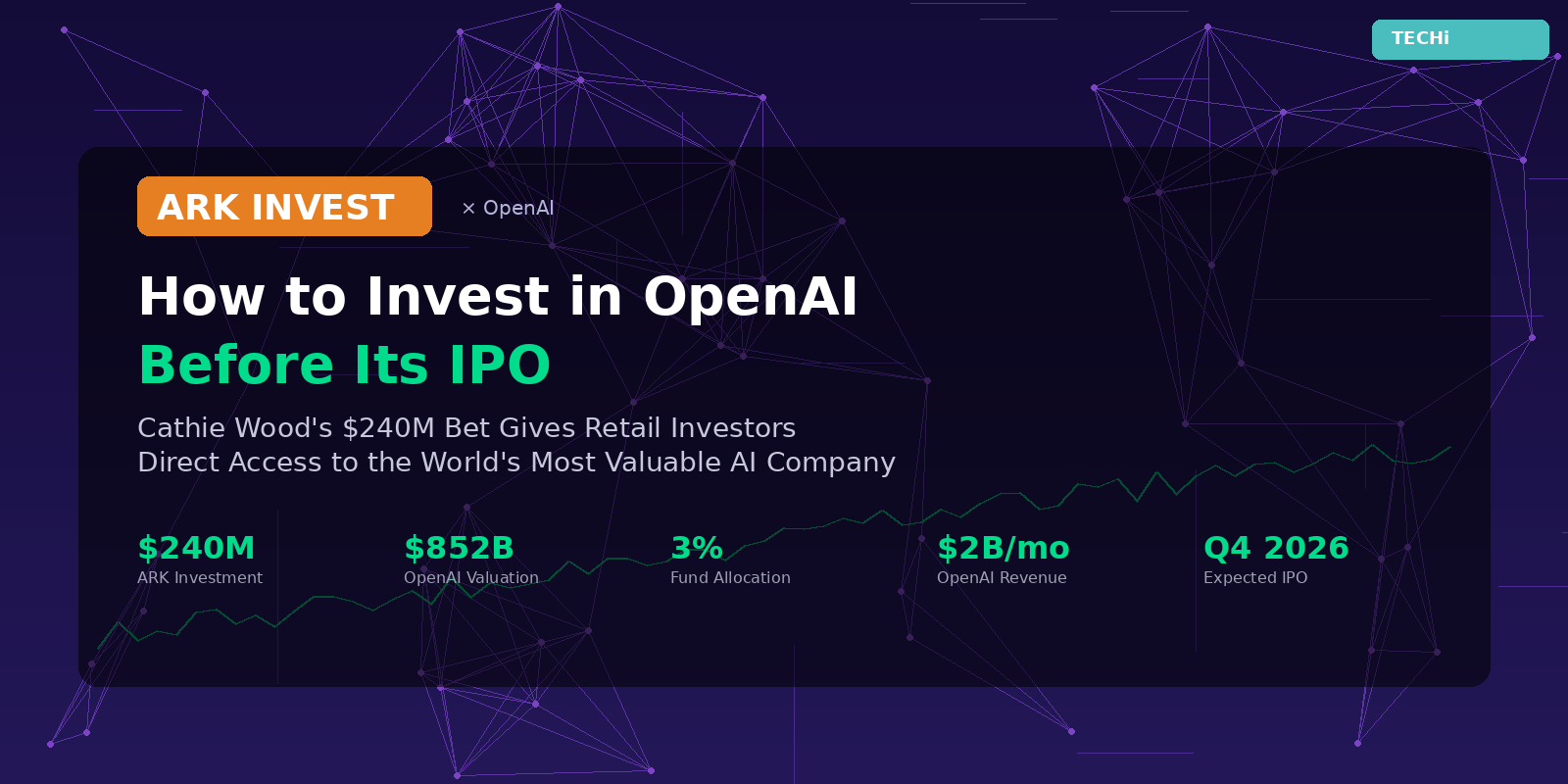
OpenAI said its March financing included more than $3 billion through bank channels for individual investors and that its shares would be included in several ARK-managed exchange-traded funds. Investors considering that route should verify the fund's current documents and holdings rather than relying on an old announcement or marketing page.
TECHi's guide to OpenAI pre-IPO access through ARK and private funds covers the practical differences between direct shares and fund-level exposure.
Private-market solicitations deserve extra caution. The SEC's pre-IPO investment alert warns that promoters may falsely claim an IPO is imminent, conceal markups, or offer shares they do not own. OpenAI's prominence makes it a particularly attractive name for that kind of pitch.
Once a listing is completed, retail investors may be able to buy shares in ordinary market trading. That is different from receiving an IPO allocation at the offering price, which brokers often reserve for selected clients and do not guarantee.
There is no confirmed OpenAI IPO date
The confidential S-1 moved OpenAI closer to the public market, but it did not start a countdown.
The sequence to watch is straightforward: a public registration statement, SEC amendments, disclosed underwriters, a proposed exchange and ticker, a preliminary price range, an effective registration statement, and final pricing. Until those steps occur, a month or quarter attached to the OpenAI IPO remains an estimate.
Readers comparing the pipeline can follow TECHi's separate Anthropic IPO guide and its analysis of the SpaceX IPO process. OpenAI's financing and governance structure still require their own analysis; another company's timetable is not a reliable clock for this offering.
The confidential submission settles one question: OpenAI has created a formal path to go public.
It leaves the questions that determine investment value unresolved. Public shareholders need to know what common stock emerges from the preferred-capital structure, how much fresh and existing capital moves at listing, what rights the Foundation retains, how much compute growth consumes, and whether audited economics support the private valuation.
Until the public S-1 provides those answers, the disciplined position is not to guess the date. It is to know what evidence to demand when the document arrives.
FAQ
Frequently asked questions
Has OpenAI filed for an IPO?
OpenAI announced on June 8, 2026, that it had confidentially submitted a draft S-1 to the SEC. That is a meaningful procedural step, but it is not a public prospectus, an effective registration statement, or a commitment to complete an IPO.
When is the OpenAI IPO date?
OpenAI has not announced an IPO date. The company said timing remains undecided and that a listing may still be some time away. Any date circulating without a public filing or company announcement is speculation.
What will OpenAI's stock ticker and exchange be?
No ticker or exchange has been confirmed. OpenAI has also not disclosed an offering price, share count, underwriters, or proposed valuation for a public offering.
What is OpenAI worth?
OpenAI said its March 2026 financing valued the company at $852 billion on a post-money basis. That is a private financing valuation, not a confirmed IPO valuation or a guarantee of how public investors would price the company.
Can retail investors buy OpenAI stock now?
Retail investors cannot buy OpenAI shares directly through an ordinary brokerage account because the company remains private. Some funds may provide indirect exposure, but investors own the fund, not OpenAI stock, and must evaluate fees, liquidity, valuation marks, and portfolio concentration.
Is a $1 trillion OpenAI IPO valuation confirmed?
No. OpenAI has not announced a target IPO valuation. A $1 trillion figure should be treated as speculation unless it appears in a company filing, prospectus, or confirmed offering terms.
What should investors examine when OpenAI's public S-1 appears?
The most important disclosures will include audited revenue and losses, gross margins, compute commitments, cash flow, customer and partner concentration, the post-offering share structure, nonprofit control rights, preferred-stock conversion, dilution, selling shareholders, lockups, and use of proceeds.
Disclaimer
This article is for informational purposes only and does not constitute financial, investment, tax, or legal advice. Market data, tax rules, and prices can change after the article date. TECHi and its authors may hold positions in securities or digital assets mentioned. Always conduct your own research and consult a licensed financial, tax, or legal professional before making decisions.
About the Author

Hafsa Rizwan is a seasoned writer and proofreading editor at TECHi, where she leads a team of writers to deliver impactful technology coverage. She reports on the stories behind the tech headlines, providing deep analysis on all tech product-related news, industry giants, new product ecosystems, and app innovations. As an Architect and technology journalist, her expertise is uniquely focused on the critical shifts transforming how we connect, create, and build, a focus exemplified by her coverage of the fascinating intersection of architecture and technology.