
- The 2026 turnWashington's ~$2B quantum program (May) put the government on the cap table — $1B to IBM, ~$100M each to D-Wave, Rigetti and Infleqtion — re-rating a sector that had been sliding.
- The pure playsIonQ (trapped-ion, biggest by revenue), D-Wave (annealing, most deployed) and Rigetti (superconducting) are the main US-listed bets — all pre-profit and richly valued.
- Safer exposureIBM, Alphabet/Google, Microsoft and Amazon offer quantum upside backed by real cash flows and far less binary risk.
- ValuationsPure plays trade at extreme price-to-sales (IonQ ~100x), so milestones — not earnings — move them; 30-50% swings are normal.
- Not a quantum stockQuantumScape (QS) is a solid-state battery company, not quantum computing — a common confusion this guide clears up.
- How to play itA diversified 4-6 name basket (big-cap core + small pure-play satellites) beats betting on one architecture.
For two years, quantum computing was a trade that ran on press releases. In 2026 it got something far more concrete: the U.S. government as a shareholder. In May, Washington committed about $2 billion to the sector and took equity stakes in the companies it funded. The most volatile corner of the market suddenly had a backstop, and the stocks re-rated hard.
This is the clear-eyed version of the quantum trade: what every major quantum computing stock actually is, where the money and the milestones stand, and how to own a basket without getting whipsawed by the hype.
The 2026 catalyst: Washington's $2 billion quantum bet
The defining event for quantum computing stocks this year had nothing to do with qubits. In May 2026 the federal government moved to award roughly $2 billion across about nine companies and — crucially — to take a minority, non-controlling equity stake in each as a condition of the cash. IBM's quantum-foundry effort drew the biggest award at $1 billion, GlobalFoundries took $375 million, and D-Wave, Rigetti and Infleqtion each landed around $100 million.
The market reaction was violent: D-Wave jumped about 33%, Rigetti roughly 30% and Infleqtion about 31%, while IonQ popped 12% even though it wasn't on the direct-investment list. The move slots quantum into a widening U.S. industrial-policy portfolio that already spans semiconductors, steel, nuclear and rare earths — the same playbook that put the government on Intel's cap table. It was, as one outlet put it, a bold federal bet on computing's next era. For a sector where every company burns cash, having Washington aligned to its success put a floor under valuations that pure speculation never could.
What quantum computing stocks actually are
Classical computers store information in bits that are either 0 or 1. Quantum computers use qubits, which exploit superposition to represent 0 and 1 at once, and entanglement to link qubits so the machine can explore an exponential number of states in parallel. A few hundred stable, error-corrected qubits could, in theory, solve problems no classical supercomputer can touch — in drug discovery, materials science, cryptography, logistics and optimization.
The catch is that today's machines are noisy. The industry calls this the NISQ era (noisy intermediate-scale quantum), with systems of 100 to a few thousand physical qubits and only limited error correction. That gap — between enormous potential and minimal usable output — is why quantum computing stocks trade on roadmap milestones, not revenue. The pure plays are valued at extreme multiples of sales, so a single demo, delay or government check can move them 30-50%.
There are four hardware approaches worth knowing: trapped ions (IonQ), quantum annealing (D-Wave), superconducting circuits (Rigetti, IBM, Google) and a handful of emerging bets like neutral atoms (Infleqtion). No one knows which will scale best — and that, for an investor, is the single most important fact: the architecture race is still a binary unknown.
The pure plays
 IonQ (IONQ) — the trapped-ion leader
IonQ is the largest pure-play quantum company by revenue and the one most institutions reach for first. Its trapped-ion design offers long qubit coherence and all-to-all connectivity (any qubit can talk to any other), and it is the rare quantum name with a real, fast-growing top line: roughly $130 million in 2025 sales, with 2026 guidance of $225-245 million after more than tripling revenue in 2025. The company is targeting a 256-qubit system by year-end, has secured U.S.-based fabrication through its SkyWater acquisition, and has pushed aggressively into quantum networking — a hedge that quantum's near-term money may come from connecting machines, not just building bigger ones.
The risk is the price. The stock trades near 100 times sales, leaving no room for a stumble, and IonQ was conspicuously absent from the government's direct-investment list. Wall Street is undeterred — a Strong Buy consensus with targets ranging up to Jefferies' $100 — but those targets assume flawless execution.
 D-Wave Quantum (QBTS) — the annealing pioneer
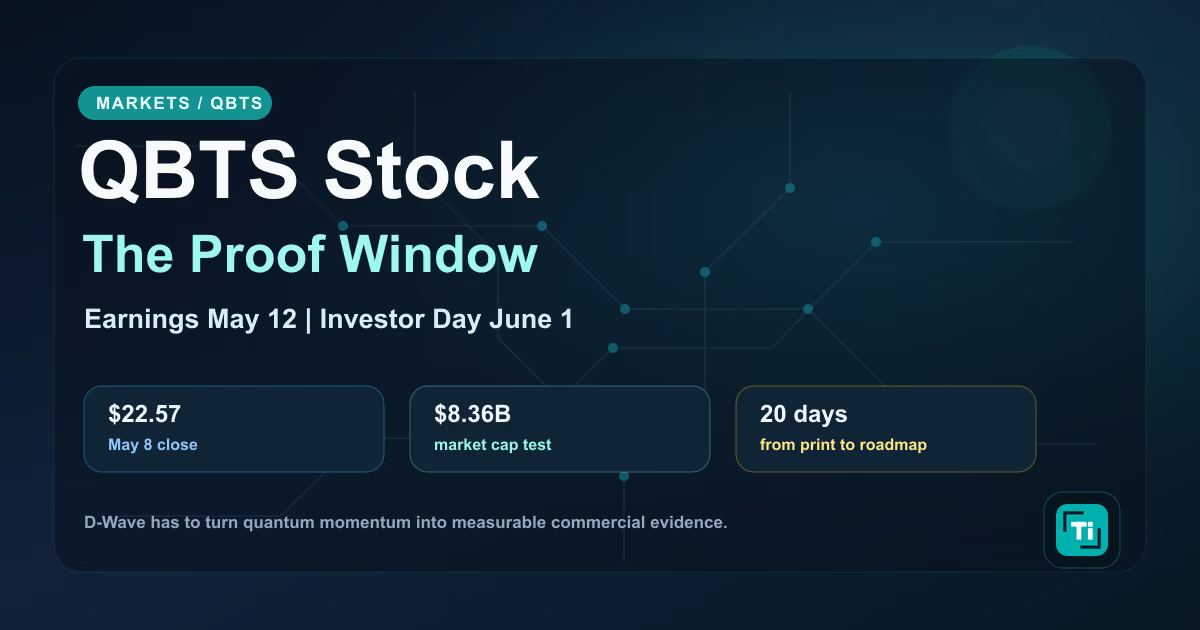
D-Wave took a different road. Instead of general-purpose gate-based machines, it built quantum annealers tuned for optimization problems, which made it the most commercially deployed quantum company in the world — and the most argued-about, since critics question whether annealing is “real” quantum computing. Its Advantage2 system packs more than 4,400 qubits, and the business runs at an unusually healthy ~83% gross margin. The $100 million federal award and equity stake handed D-Wave both validation and a cash cushion. With an all-Buy analyst slate, the debate is whether its commercial lead translates into durable scale. TECHi's full D-Wave breakdown digs into the model.
 Rigetti Computing (RGTI) — the superconducting challenger
Rigetti is the vertically integrated bet: it designs and fabricates its own superconducting chips and runs them through its own cloud, an Apple-style full-stack approach that, in theory, lets hardware and software co-optimize. It also collected a $100 million federal award. The stock is a study in volatility — it once ran more than 1,400% in a matter of months — and its credibility now rests on shipping its delayed Cepheus-1-108Q system and proving gate fidelity. Superconducting qubits are fast but fragile, needing near-absolute-zero cooling, and Rigetti's history of slipped timelines is the bear's favorite talking point. See TECHi's Rigetti analysis for the roadmap detail.
The higher-risk fringe: Infleqtion and QUBT
Infleqtion, a neutral-atom developer, was one of the ~$100 million government winners and is an emerging name to watch. Quantum Computing Inc. (QUBT) also appears on most quantum lists, but it is a micro-cap with a thin commercial record and deserves extreme caution — a lottery ticket, not a core holding.
The big-cap quantum (exposure with a safety net)
IBM — the enterprise quantum giant
IBM is the only player that pairs decades of quantum research with a profitable core business, and it was the single biggest winner of the government program, taking $1 billion to help build America's first purpose-built quantum foundry. Its roadmap is the most concrete in the industry: the Nighthawk processor (120 qubits, up to 7,500 two-qubit gates), a new qLDPC error-correction scheme that needs fewer physical qubits, and a public promise to ship “Starling,” a large-scale fault-tolerant machine, by 2029, with a longer arc toward 2,000-qubit, billion-gate systems by 2033. Because consulting, software and hybrid cloud generate the cash, IBM lets investors own the quantum option without betting the farm on it.
Alphabet/Google — the dark horse
Google's quantum work is overshadowed by search and ads, but it produced the milestone the whole field was waiting for: its Willow chip demonstrated below-threshold error correction — adding more physical qubits actually reduces the logical error rate instead of amplifying it. That is the precondition for scaling to useful machines. With Alphabet's balance sheet behind it, Google may be the most formidable long-term competitor of all, and the quantum upside is essentially a free option on top of the ad and cloud business.
Microsoft, Amazon and Nvidia — the platform plays
Microsoft (Azure Quantum), Amazon (AWS Braket) and Nvidia (the CUDA-Q hybrid software stack) offer indirect exposure: they monetize quantum as cloud and tooling rather than as hardware bets. For these trillion-dollar companies quantum is a rounding error — which is exactly the point for risk-averse investors.
 Not a quantum stock: QuantumScape (QS)
One housekeeping correction, because it trips up a lot of investors: QuantumScape (QS) is not a quantum computing company. It builds solid-state batteries for electric vehicles — “Quantum” is a brand name, not a reference to qubits. It frequently surfaces in quantum-stock searches by accident. If you own QS, you own an EV-battery bet (covered in TECHi's QuantumScape analysis); it should not be in a quantum-computing basket.
The bull case
The optimistic read is straightforward. The government just validated the sector with cash and equity stakes; Google has proven error correction improves with scale; IBM has put a 2029 date on fault tolerance; and revenue, while small, is growing fast (IonQ revenue +202% in 2025, D-Wave at an ~83% gross margin). If Jefferies' projection of a ~$198 billion quantum market by 2040 is even directionally right, today's combined pure-play market caps are a rounding error against the prize. Bulls see this as the early-internet moment — messy and overvalued in spots, but early.
The bear case
The skeptical read is just as clear. These are pre-profit companies valued at extreme multiples of tiny revenue, in a NISQ era where error rates still cap real-world usefulness. The architecture race is unresolved, so backing a single pure play is a binary wager. “Fault-tolerant by 2029” is a roadmap, and quantum roadmaps slip routinely. Government money buys runway and credibility, but it does not make any of these companies profitable — and a single missed milestone can erase a year of gains in a session.
How to build a quantum position
The honest answer is that no one can pick the winning architecture today, so the structure matters more than the stock. A sensible approach: anchor with a big-cap core (IBM and Alphabet, where quantum is upside rather than survival), then add small, equally weighted satellite positions across the pure plays (IonQ, D-Wave, Rigetti) so that one company's breakthrough — or blowup — doesn't make or break the thesis. Size every position for a 50% drawdown, treat the whole sleeve as a multi-year option rather than a trade, and rebalance on milestones, not headlines. The broader AI-and-compute complex is where most of this capital ultimately competes for attention.
Key dates for quantum investors
- End of 2026 — IonQ's targeted 256-qubit system.
- 2026-2027 — Rigetti's delayed Cepheus-1-108Q, and the government-funded roadmaps at D-Wave, Rigetti and Infleqtion that now have to deliver.
- 2029 — IBM's target for “Starling,” its first large-scale fault-tolerant machine.
- 2033 — IBM's longer-range goal of ~2,000-qubit, billion-gate systems.
- Every quarter — pure-play revenue prints (IonQ is the bellwether) and milestone demos, any of which can move the group 30-50%.
The bottom line
The government's $2 billion and its equity stakes put a floor under a sector that still runs on milestones, and the underlying technology is genuinely advancing — Willow's error correction and IBM's roadmap are real. But profitability is years away and valuations price perfection. Own quantum computing stocks as a small, diversified, long-horizon option — not a sure thing. The next checkpoints to watch: IonQ's 256-qubit system, Rigetti's Cepheus, and whether the newly government-funded roadmaps actually hit their dates.
FAQ
Frequently asked questions
What are the best quantum computing stocks in 2026?
The most-watched US-listed names are the pure plays IonQ (IONQ), D-Wave Quantum (QBTS) and Rigetti (RGTI), plus lower-risk big-cap exposure through IBM, Alphabet (Google), Microsoft and Amazon. Which is “best” depends on risk tolerance: big-caps are far safer, the pure plays are higher-risk and higher-reward.
Did the US government invest in quantum computing stocks?
Yes. In May 2026 the U.S. committed about $2 billion across roughly nine companies — $1 billion to IBM's quantum-foundry effort, around $100 million each to D-Wave, Rigetti and Infleqtion, and $375 million to GlobalFoundries — and took minority, non-controlling equity stakes as a condition of the funding.
Is IonQ (IONQ) a good stock?
IonQ is the largest pure play by revenue (about $130 million in 2025, with 2026 guidance of $225-245 million) and carries a Strong Buy consensus, but it trades near 100 times sales — a high-risk, milestone-driven bet rather than a value play.
What is the difference between IonQ, D-Wave and Rigetti?
IonQ uses trapped ions, D-Wave uses quantum annealing (optimization-focused and the most commercially deployed), and Rigetti builds superconducting chips across the full stack. They are betting on different hardware architectures, and which one scales best is still unresolved.
Is QuantumScape a quantum computing stock?
No. QuantumScape (QS) is a solid-state EV battery company; “Quantum” is only its brand name. It often turns up in quantum-stock searches by mistake but has nothing to do with quantum computing.
Are quantum computing stocks profitable?
Mostly not. The pure plays generate well under $250 million in revenue and are not profitable; their valuations rest on future potential. IBM and Alphabet are highly profitable, but quantum is only a tiny part of those businesses.
What is the safest way to invest in quantum computing?
Through diversified big-caps (IBM, Alphabet, Microsoft, Amazon) that have real cash flows, or a small basket of four to six names rather than a single pure play — because which architecture ultimately wins is still a binary unknown.
When will quantum computing be commercially useful?
The field is in the NISQ era (noisy, 100-2,000 qubits). IBM targets a large-scale fault-tolerant machine, “Starling,” by 2029, and Google has shown error rates falling as qubits scale — but broad commercial usefulness is widely seen as still years away.

Disclaimer
This article is for informational purposes only and does not constitute financial, investment, tax, or legal advice. Market data, tax rules, and prices can change after the article date. TECHi and its authors may hold positions in securities or digital assets mentioned. Always conduct your own research and consult a licensed financial, tax, or legal professional before making decisions.
About the Author
Jazib ZamanJazib Zaman founded TECHi in 2010 and is chief executive of its publisher, TechAbout LLC. He is a former member of the Forbes Technology Council. His TECHi writing covers AI infrastructure, semiconductor businesses and the financial tradeoffs of adopting new technology. His published work includes company earnings and valuations, AI software costs, and the effect of technology investment on public markets.



Comments