


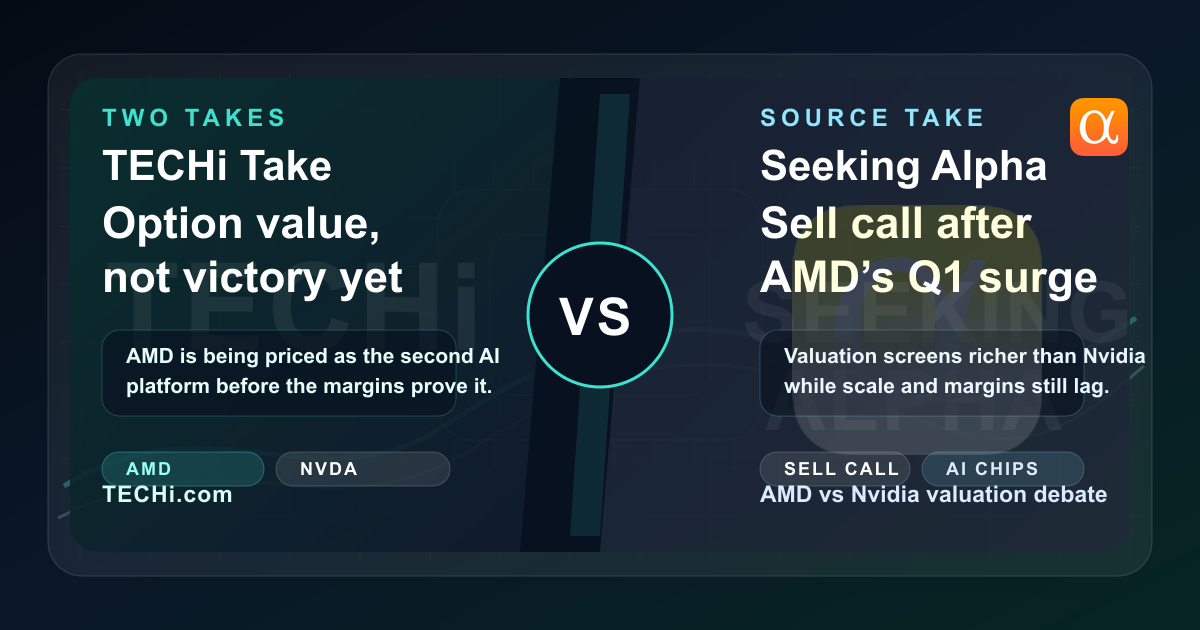
Seeking Alpha's May 7 downgrade of AMD is useful because it argues the stock has become expensive for the right reason: investors now believe AMD can be the credible second AI infrastructure platform next to Nvidia. The mistake would be treating that as proof AMD has already flipped Nvidia's economics.
At about 12:57 p.m. EDT on May 8, 2026, market data showed AMD near $442.48, up roughly 8.3% on the session, while Nvidia traded near $215.22, up about 1.7%. That price action explains why the sell call landed: AMD is no longer a quiet catch-up trade. It is a stock being asked to justify a platform premium.
TECHi's take: AMD has option value, not Nvidia-like economics yet
The cleanest read is not that AMD has beaten Nvidia. It has not. The cleanest read is that AMD's valuation has started to price a future in which hyperscalers treat AMD as the scarce second full-stack AI platform. That is different from saying AMD has Nvidia-like economics today.
The Seeking Alpha downgrade rests on a real valuation risk. James Foord argues that AMD's valuation has moved past Nvidia on some P/E and PEG screens while AMD still trails Nvidia in margins, AI accelerator share and ecosystem depth. That warning should not be dismissed. AMD is coming off a violent move after earnings, and a stock that runs ahead of proof can be punished even when the business keeps improving.
The primary-source numbers show both sides of the debate. AMD's Q1 2026 release reported $10.253 billion of revenue, non-GAAP diluted EPS of $1.37, non-GAAP gross margin of 55%, and Data Center revenue of $5.775 billion, up 57% year over year. The company also guided Q2 revenue to roughly $11.2 billion, plus or minus $300 million.
That is a serious acceleration, not hype. It also explains why the market is willing to debate AMD as more than a cyclical CPU/GPU supplier. If customers want a second high-end AI accelerator platform, AMD's smaller base becomes an advantage for growth math. Every additional hyperscaler win moves the model faster than it would for a company already generating Nvidia-scale data-center revenue.
But Nvidia's latest reported scale remains in another category. Nvidia's Q4 fiscal 2026 release showed quarterly revenue of $68.1 billion, quarterly Data Center revenue of $62.3 billion, non-GAAP gross margin of 75.2%, and fiscal-year revenue of $215.9 billion. Nvidia also guided fiscal Q1 2027 revenue to $78.0 billion, plus or minus 2%, while assuming no Data Center compute revenue from China.
That chart is the whole debate in one frame. AMD's stock can be expensive and AMD's business can still be getting strategically stronger. The market is not paying AMD because it already looks like Nvidia. It is paying AMD because the AI buildout is large enough that a credible second supplier can be worth far more than its current income statement suggests.
That is why the phrase "flipped Nvidia" needs precision. AMD may have flipped the sentiment cycle. It may have flipped the narrative from catch-up vendor to serious platform candidate. It may even have flipped some valuation screens. It has not flipped Nvidia's scale, gross-margin structure, software default position or data-center dollar base.
The more useful investor question is therefore not whether AMD is a sell or Nvidia is a buy. It is what type of risk the investor is being paid to own. Nvidia is the dominant platform with massive cash flow, superior margins and a higher bar for surprise. AMD is the challenger with faster percentage growth, a smaller revenue base and a cleaner second-source story if MI450, Helios and EPYC keep gaining share.
TECHi's AMD Q1 analysis already framed the quarter as a data-center mix shift, not merely an EPS beat. The follow-up AI platform test is even more important after this downgrade: AMD has to prove that strong demand converts into a durable platform, not just a few quarters of accelerator shipments. That is also the strategic context behind AMD's Meta infrastructure deal and the broader AMD vs Nvidia stock comparison.
For investors who bought AMD before the earnings run, the Seeking Alpha downgrade is a useful risk-control prompt. Some of the easy upside may now depend on second-half execution and margin proof. For investors comparing AMD and Nvidia from fresh capital, the right split may be less dramatic: Nvidia still owns the default AI platform trade, while AMD owns the higher-beta second-platform option.
That makes the TECHi take more nuanced than a simple rebuttal. The downgrade is not absurd. The valuation concern is real. The part that needs adjustment is the framing. AMD has not become Nvidia. It has become expensive because the market is finally assigning value to the possibility that it does not need to become Nvidia to matter.

Comments
Comment as a guest or sign in with your account. Comments appear after moderation. Please follow our comments policy.