

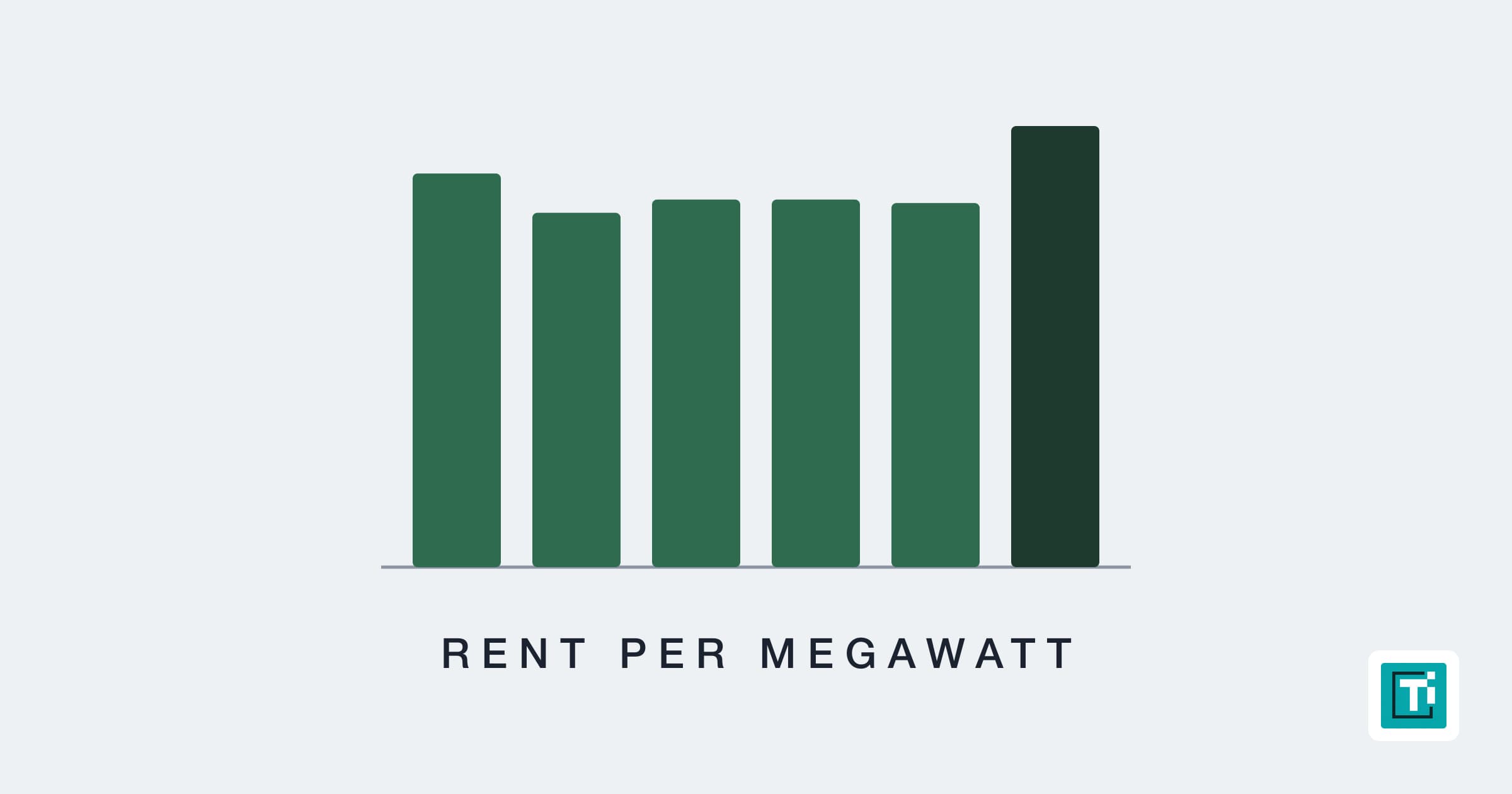
Editorial illustration drawn to scale from CoreWeave's stock-market value at the November 27, 2026 close, its debt at September 30 (darker bar) and its revenue backlog. Illustration: TECHi, from Nasdaq prices and CoreWeave's filings.
CoreWeave, which rents out AI computing power, ended November with a stock-market value of about $24.6 billion, roughly half the $46.9 billion of debt on its balance sheet at the end of September, TECHi calculates from its quarterly report and Nasdaq closing prices. The company also reported a revenue backlog of $132.5 billion, more than five times its market value.
The shares closed at $44.15 on Friday, down 19.5% in November and 49.3% since September 30. They had jumped 24.7% on November 11, the day after CoreWeave raised its full-year forecasts for revenue and adjusted operating income, and have since fallen 27.3% from that close.
Key Takeaways
- ValueCoreWeave ended November worth about $24.6 billion, roughly half its $46.9 billion of debt.
- BacklogIts revenue backlog of $132.5 billion is about 5.4 times its market value.
- InterestInterest expense took about 23% of third-quarter revenue and is forecast above $1 billion in the fourth quarter.
- SpendingIts 2026 capex forecast implies $13.4 billion to $15.4 billion in the fourth quarter.
- SharesDown 19.5% in November and 49.3% since September 30.
How much does CoreWeave owe?
At September 30, CoreWeave had $41.6 billion of recourse debt, which its lenders can claim against the company as a whole, and $5.3 billion of non-recourse debt, which is tied to specific assets, according to its balance sheet. Together that is $46.9 billion, up 119% from $21.4 billion at the end of 2025. Recourse debt alone rose from $20.7 billion at the end of 2025 to $41.6 billion, roughly doubling in nine months. Of the total, $10.6 billion was due within a year, against $4.1 billion of cash and cash equivalents and $1.4 billion of current restricted cash.
The company also had $18.7 billion of operating lease liabilities and total liabilities of $87.5 billion, against total assets of $91.5 billion. Total liabilities have risen by $41.5 billion since the end of 2025. Stockholders' equity was $4.0 billion, down from $5.0 billion three months earlier.
| Item | Dec. 31, 2025 | Sept. 30, 2026 |
|---|---|---|
| Total debt | $21.4B | $46.9B |
| Debt due within a year | $6.7B | $10.6B |
| Total liabilities | $46.0B | $87.5B |
| Remaining performance obligations | $60.7B | $132.3B |
| Deferred revenue | $8.2B | $10.0B |
| Cash and cash equivalents | $3.1B | $4.1B |
| Property and equipment, net | $30.6B | $56.8B |
What does it earn against that debt?
Revenue in the third quarter was $3.7 billion, up 168% from a year earlier, and operating income was $207 million, according to the results release. Net interest expense was $846 million, up 173% from a year earlier and equal to about 23% of revenue, TECHi calculates. The net loss was $709 million.
CoreWeave's own forecasts point to more of the same. It expects fourth-quarter interest expense of $1.05 billion to $1.15 billion. Its full-year revenue forecast of $13.0 billion to $13.3 billion implies fourth-quarter revenue of about $4.7 billion to $5.0 billion, so interest would take roughly 21% to 25% of revenue, TECHi calculates. That revenue range would be 28% to 36% above the third quarter.
The company reports a far stronger picture before interest and depreciation. Its adjusted EBITDA, a measure that leaves out both, was $2.3 billion in the third quarter, or 62% of revenue, and it raised its full-year forecast for adjusted operating income to $1.275 billion to $1.375 billion.
How big is the backlog?
CoreWeave said its revenue backlog was about $132.5 billion at September 30, including remaining performance obligations of $132.3 billion reported in its quarterly filing. Those obligations rose by $28.6 billion in the third quarter alone and have more than doubled from $60.7 billion at the end of 2025.
The backlog is equal to about 5.4 times the company's market value at Friday's close. It is revenue that customers have committed to pay over several years, subject to CoreWeave delivering the computing capacity, so it also implies large spending to build that capacity.
Who is buying the capacity?
CoreWeave said in the release that it won customers across AI labs, cloud providers and businesses in the third quarter, naming Canva, Mirendil, Parallel Web Systems, Serve Robotics, Substack and Wayve, and that it expanded work with existing customers. It said it still expects more than 1.85 gigawatts of active power at the end of the year, and it raised its forecast for annualized run-rate revenue at the end of 2026 to $20 billion to $21 billion.
How much is it still spending?
CoreWeave expects capital spending of $37 billion to $39 billion this year, after raising the low end of its range in November because it expects to deliver infrastructure to customers sooner than planned. It spent $23.6 billion in the first nine months, including $9.4 billion in the third quarter, so the forecast implies $13.4 billion to $15.4 billion in the fourth quarter, TECHi calculates.
Chief Executive Michael Intrator said in the release that growth was supported by "multiple sources of funding," including financing backed by customer contracts, operating cash flow and about $9 billion in customer prepayments and deposits expected in the three months after the release. Customers had already paid ahead for some capacity: the balance sheet showed $10.0 billion of deferred revenue at September 30, against $8.2 billion at the end of 2025. The roughly $9 billion of expected prepayments compares with $13.4 billion to $15.4 billion of fourth-quarter capital spending implied by its forecast.
What happened to the shares after the results?
The rally after the results did not last. From $48.73 on November 10, the day of the release, the shares rose to $60.77 the next day, then fell to $39.51 by November 20, when AI hardware stocks dropped sharply across the board. They recovered to $44.15 by Friday, still below where they stood before the results.
At Friday's close, CoreWeave's market value was about $24.6 billion, against about $33.8 billion after the post-results jump and $48.4 billion at the end of September, TECHi calculates from the 556 million shares on the cover of its quarterly report. Its total liabilities of $87.5 billion were 3.6 times its market value.
What did the results show about margins?
Revenue rose by more than $1 billion from the second quarter, which Intrator called "a breakout quarter." On the company's adjusted measure, operating income was $379 million, or 10% of revenue, against $217 million, or 16%, a year earlier, according to the release. Net loss for the first nine months of the year was $2.08 billion.
The company's property and equipment, net of depreciation, rose to $56.8 billion at the end of September from $30.6 billion at the end of 2025.
How has the market valued it?
Adding debt and subtracting cash, CoreWeave's enterprise value was about $67.3 billion at Friday's close, TECHi calculates. That is about 3.2 to 3.4 times the annualized revenue run rate of $20 billion to $21 billion that the company expects to reach at the end of 2026.
The shares were 68% below their highest close of the past year, $137.98 on May 6. In November, CoreWeave lost 19.5% of its value, part of a month in which Nvidia and nine other AI hardware stocks lost about $1.9 trillion, as TECHi reported on Saturday. On October 16, the shares fell about 12% in a single session, as TECHi reported at the time.
CoreWeave is also a large tenant in the data center market. It leases 400 megawatts at Applied Digital's Polaris Forge 1 campus in North Dakota under a lease worth $10.71 billion over its 15-year base term, about $714 million a year, as TECHi reported on Friday.
What to watch
- CoreWeave's next quarterly results, against implied fourth-quarter revenue of about $4.7 billion to $5.0 billion.
- Debt due within a year of $10.6 billion, and any new financing backed by customer contracts.
- Whether the roughly $9 billion of customer prepayments and deposits it expected arrives.
- Active power of more than 1.85 gigawatts by year-end, which the company says it still expects.
- Interest expense, which CoreWeave expects to exceed $1 billion in the fourth quarter.

Disclaimer
This article is for informational purposes only and does not constitute financial, investment, tax, or legal advice. Market data, tax rules, and prices can change after the article date. TECHi and its authors may hold positions in securities or digital assets mentioned. Always conduct your own research and consult a licensed financial, tax, or legal professional before making decisions.



Comments