

Illustrative server-room photograph; this is NOIRLab equipment, not a CoreWeave facility. Photo: NOIRLab/NSF/AURA/T. Slovinský, CC BY 4.0. Cropped and marked by TECHi. Source: https://noirlab.edu/public/images/6V6A0375-CC/
CoreWeave shares were down more than 11% in Friday trading, according to a Reuters report updated at 12:57 p.m. ET. The selloff had spread across companies that build and lease computing capacity for artificial intelligence: Reuters reported a roughly 10% decline in Nebius and drops of about 9% in Applied Digital and IREN. These are intraday observations, not closing prices. They may change before the bell.
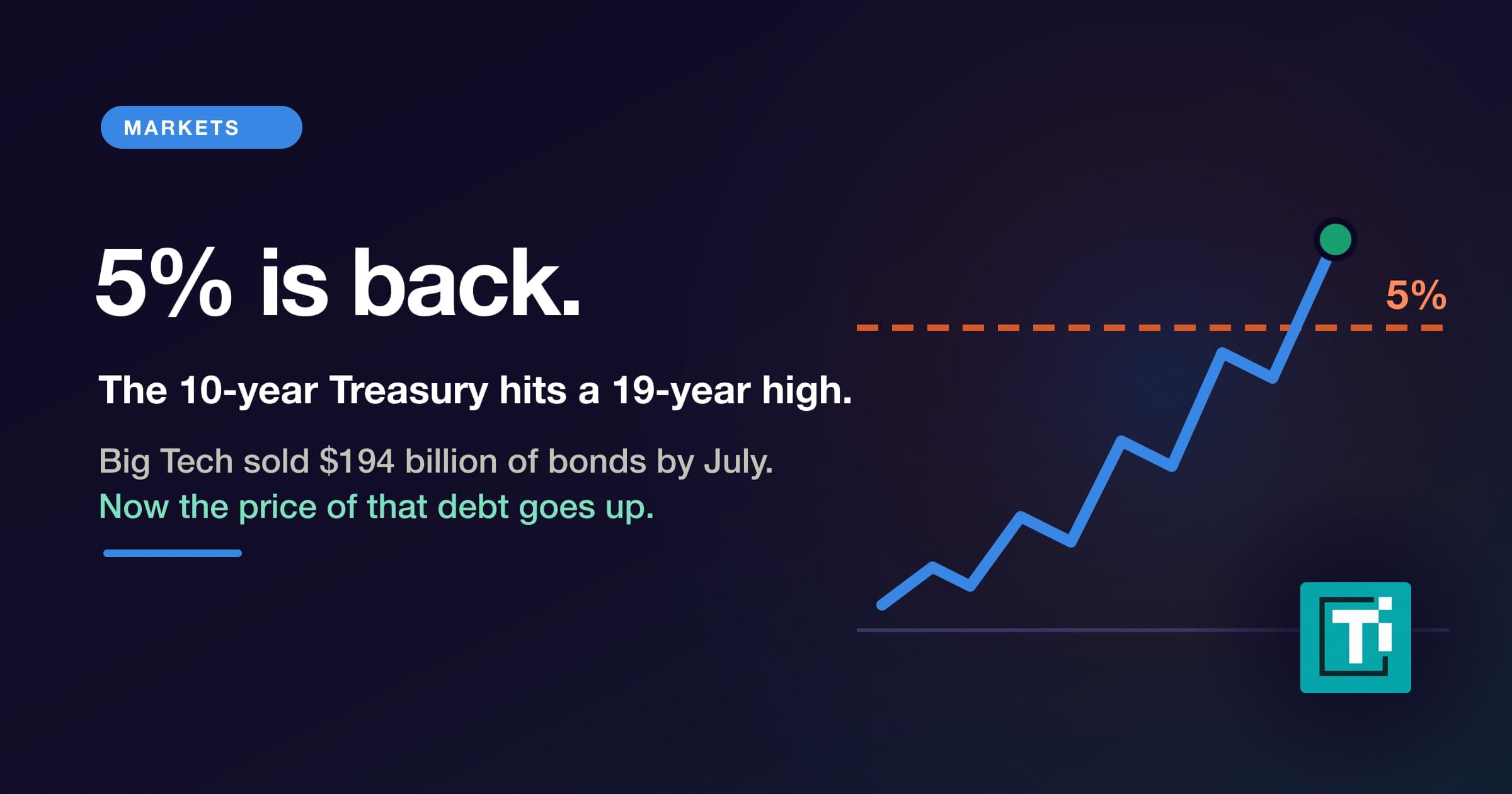
The striking feature of CoreWeave's move is that the anxiety is visible in two markets at once. Shareholders are marking down the value of its future profits. Bondholders are asking for more compensation to lend against the machinery and buildings needed to earn those profits. On Thursday, the yield on one CoreWeave dollar bond due in October 2031 briefly exceeded 16%, Reuters reported. A rising secondary-market yield means the bond's price has fallen; it does not mean every dollar CoreWeave has already borrowed suddenly costs 16%.
That distinction matters. This is not evidence that demand for AI computing has vanished, nor proof that CoreWeave is about to miss a payment. It is a financing question: can a company with a huge order book turn those commitments into working capacity and cash at a price that leaves enough for shareholders? The answer depends on timing as much as demand.
Why the debt market changes the stock story
CoreWeave rents specialized computing power to customers building and running AI models. The servers have to be ordered, installed, powered and connected before much of the contracted revenue can arrive. In a conventional software company, adding a customer may require relatively little physical spending. In CoreWeave's model, winning a large customer can create an immediate need for capital.
That is why this week's bond move is more than an obscure fixed-income footnote. If new capacity has to be funded at more expensive rates, a project that looked attractive under cheaper borrowing may return less than expected. Lenders can also demand tighter terms, more collateral or a smaller advance. None of those outcomes automatically invalidates a signed customer contract. Each can alter the economics between signing it and delivering the compute.
The company warned in its June 2026 Form 10-Q that it expects significant future investment and may need more debt or equity financing. It also said financing might not be available on terms it likes. That was a disclosed business risk before Friday's slide; the current market action is a live test of how seriously investors take it.
The opposite case deserves room. A fall in the trading price of an outstanding bond does not itself cut off a company from all funding. CoreWeave had cash and committed borrowing capacity in its last filed quarter. Reuters also reported that Evercore analysts kept an outperform rating, arguing that a higher bond yield should not be read as proof that the underlying business model has failed. The market is repricing risk, not delivering a final verdict.
The numbers investors should keep separate
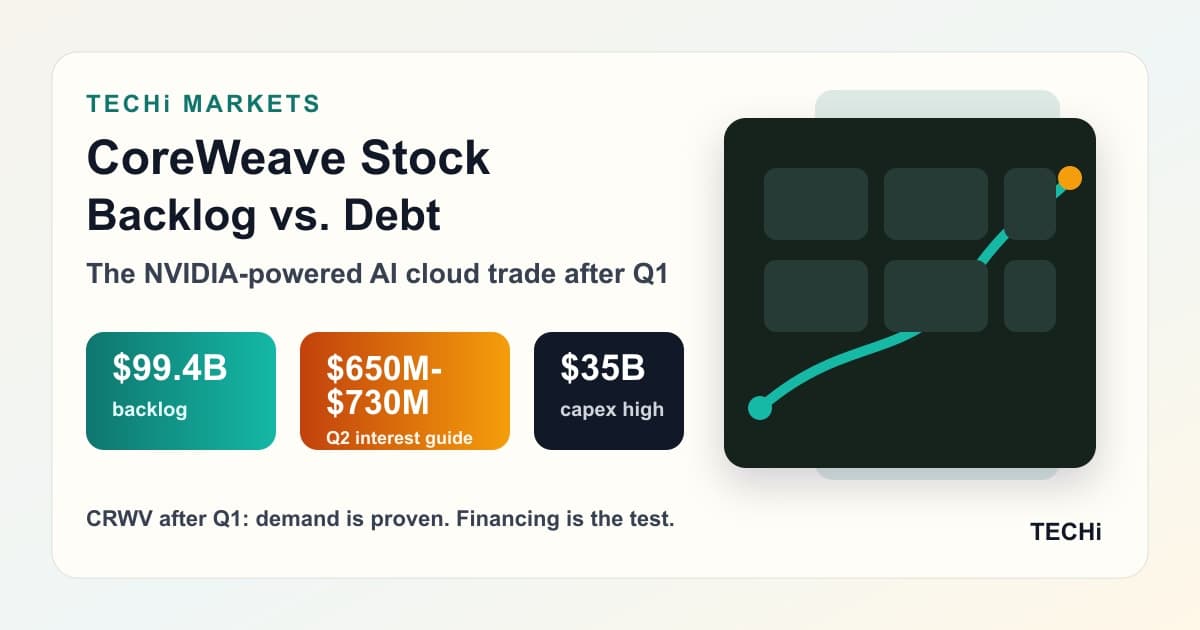
CoreWeave's latest filed quarter presents three figures that are often compressed into one alarming headline. As of June 30, its balance sheet listed about $35.1 billion of current and long-term recourse and non-recourse debt, plus roughly $16.3 billion of operating-lease liabilities. These are different obligations. Adding them gives a broad picture of financing and lease commitments, but calling the entire sum ordinary bond debt blurs how each item is paid and secured. The balance sheet makes the categories visible.
The company's own liquidity measure was $15.55 billion at June 30. That included about $5.52 billion in cash and cash equivalents, $15 million in marketable securities and approximately $10.01 billion of availability under existing facilities. Availability under a secured facility is not the same thing as cash sitting in an unrestricted bank account. Borrowing can depend on eligible assets, documentation and the terms of the facility. Likewise, the last filed figure is a historical snapshot, not a live statement of Friday's cash balance.
Its reported second-quarter revenue was $2.575 billion, more than double the prior-year quarter. Yet the same earnings release filed with the SEC reported a $49 million operating loss, $640 million of net interest expense, and a $626 million net loss. The interest line was about a quarter of quarterly revenue. It is tempting to divide one number by another and announce that AI demand cannot pay the bill. That would go too far: a fast-growing business has uneven timing, and accounting interest, cash interest, capitalized interest and debt principal are not interchangeable.
Still, the combination explains the tension in the stock. Revenue growth alone does not settle what remains after funding the physical infrastructure. CoreWeave reported $1.51 billion in adjusted EBITDA for the quarter, a metric that can help compare operating performance. It does not deduct the full cost of building new capacity and is not a substitute for free cash flow. The gap between operating scale and the capital bill is precisely where the credit market is focusing.
A $104 billion backlog is a promise with work attached
CoreWeave said its revenue backlog was about $104 billion at June 30. That is substantial evidence of customer demand. The footnote is equally important: the company's measure includes remaining performance obligations and other estimated future revenue from committed contracts, subject to delivery and service availability. It is not $104 billion in collected cash. The company's release also said the figure excluded more than $25 billion of net new commitments added in early Q3.
A useful way to read backlog is as a schedule of future execution. The customer may be committed, but CoreWeave still has to bring capacity online, meet specifications and keep the service running. If a data center is delayed, power is unavailable or a GPU installation takes longer than planned, the expected revenue can move further into the future while financing costs continue. The company itself lists third-party data-center delivery, power and interconnection among the risks in its 10-Q.
Nor does backlog reveal the margin on every contract. A $1 billion commitment financed cheaply and delivered promptly can be more valuable to equity holders than a larger commitment that requires expensive, delayed infrastructure. That is the fresh investor question behind Friday's decline. Investors are no longer rewarding the nominal size of future AI orders without asking how the machines will be paid for and when they will earn.
The company has genuine commercial strength. Its filing names major agreements with customers including OpenAI and Meta, and the revenue increase shows capacity is already reaching production. But concentration cuts both ways. A few very large buyers can underpin growth, while changes in their demand, schedules or willingness to perform can have an outsized effect. This is why looking only at the top-line backlog misses part of the equity risk.
Cash flow shows both progress and dependence on financing
For the first six months of 2026, CoreWeave's cash-flow statement and management discussion showed $3.66 billion provided by operating activities, compared with cash used in operations a year earlier. That is real progress. It also showed $14.87 billion used in investing activities and $13.99 billion provided by financing activities. The company was building far faster than operating cash alone could fund.
Those figures should not be mistaken for a simple annual run rate. Large equipment purchases and financing draws can land in particular quarters. What they do show is the shape of the model: operating cash is growing, but expansion still relies heavily on external capital. If financing becomes more expensive, the effect is not limited to the next bond coupon. It may influence which sites are built first, which GPUs are deployed, and how much financial flexibility remains when a project slips.
There is a second timing issue. A customer contract can run for years, while much of the spending to satisfy it happens before the first full stream of invoices. A lender is concerned with the bridge between those dates. An equity investor is concerned with what is left after crossing it. The two markets are therefore asking related questions, but neither market alone has a complete answer.
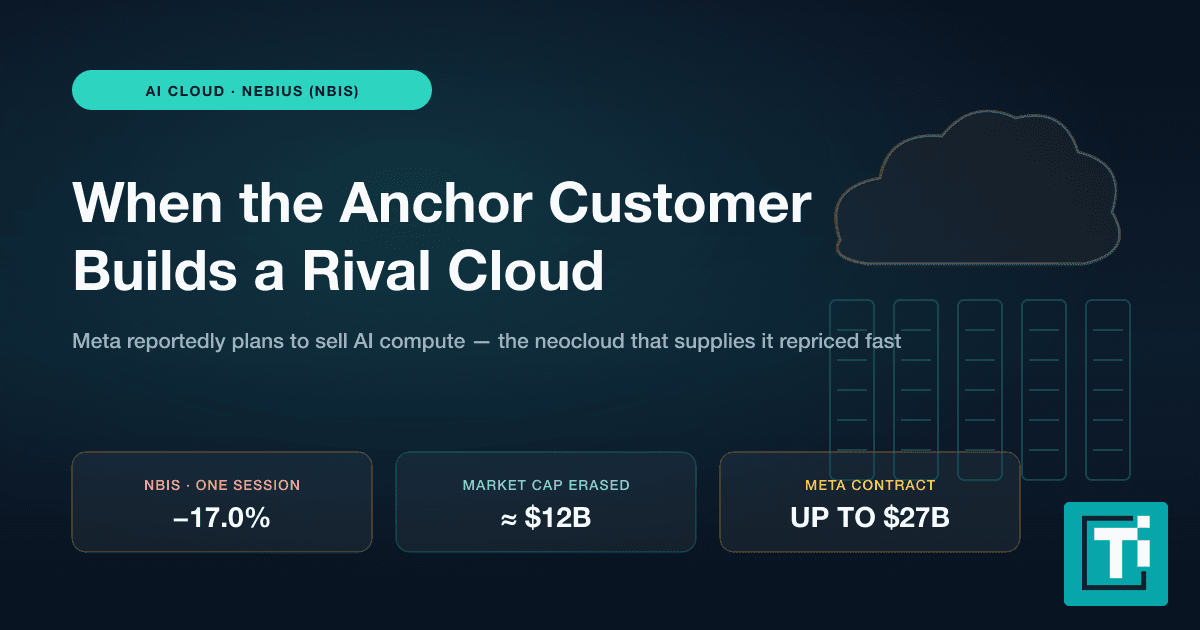
This also helps explain why the selloff reached peer stocks. A funding premium attached to AI infrastructure is not unique to one company if competitors use the same debt-financed buildout pattern. Reuters reported losses in Nebius, Applied Digital and IREN on Friday. Their balance sheets and contracts are not identical to CoreWeave's, so the price moves should not be treated as proof of identical credit risk. They do show that investors are reassessing the sector's cost of capital together.
What could change the picture
The bearish interpretation is straightforward: bond yields stay elevated, new projects cost more to fund, and the cash from signed contracts arrives too slowly to offset the increased financing burden. In that case, even strong AI usage would not guarantee attractive returns for CoreWeave shareholders. A company can grow revenue and still disappoint equity investors if much of the gain is absorbed by lenders, landlords and equipment suppliers.
The constructive interpretation is also plausible. CoreWeave could bring contracted capacity online on schedule, lift operating cash generation as sites mature and secure financing on terms better than the most stressed bond trades suggest. Its June 10-Q said management believed existing cash, short-term investments and borrowing availability would cover obligations expected within the following year. That statement is management's assessment as of the filing date, not a promise that markets cannot change.
The next useful evidence is specific. Investors should watch whether CoreWeave reports additional committed financing, at what cost and against what collateral; how much capacity becomes available to customers; and whether operating cash rises relative to the investment needed for growth. They should also distinguish a recovery in an existing bond's market price from a new financing deal actually struck by the company. One is a signal. The other changes the business's funding terms.
Quarterly earnings will matter, but a single headline revenue beat may no longer be enough. The most revealing comparison will be between contracted demand, capacity brought into service, interest expense, capital spending and cash generation. A backlog number answers how much work has been won. It does not answer how much money the work will ultimately make for common shareholders.
The Friday takeaway
As of the Reuters report updated at 12:57 p.m. ET on October 16, CoreWeave shares were down more than 11% and the AI-infrastructure selloff had widened. Thursday's bond-yield spike added a sharper question than the familiar debate over whether AI demand is real. Demand is visible in CoreWeave's revenue and contracts. The unresolved issue is the financing bridge between those contracts and the servers needed to fulfil them.
That bridge is what makes CoreWeave one of the clearest tests of the AI buildout. The company's filings show a large backlog, rapid revenue growth, substantial liquidity, heavy investment and substantial debt and lease obligations. None of those facts alone makes the stock cheap or expensive. Together, they explain why a change in lending appetite can move the equity so violently.
Friday's prices remain intraday. A rebound before the close would not erase the financing question, just as another decline would not establish insolvency. The durable story is whether CoreWeave can keep converting its order book into available capacity and cash while lenders remain willing to fund the construction at a workable price.

Disclaimer
This article is for informational purposes only and does not constitute financial, investment, tax, or legal advice. Market data, tax rules, and prices can change after the article date. TECHi and its authors may hold positions in securities or digital assets mentioned. Always conduct your own research and consult a licensed financial, tax, or legal professional before making decisions.
About the Author

Omer Sheikh is a markets editor at TECHi. His published work covers public companies, with particular attention to AI infrastructure, semiconductors, Tesla and SpaceX. His portfolio includes company results, stock comparisons and conditional forecasts, examining demand, capital spending and the business assumptions behind market valuations.


Comments