

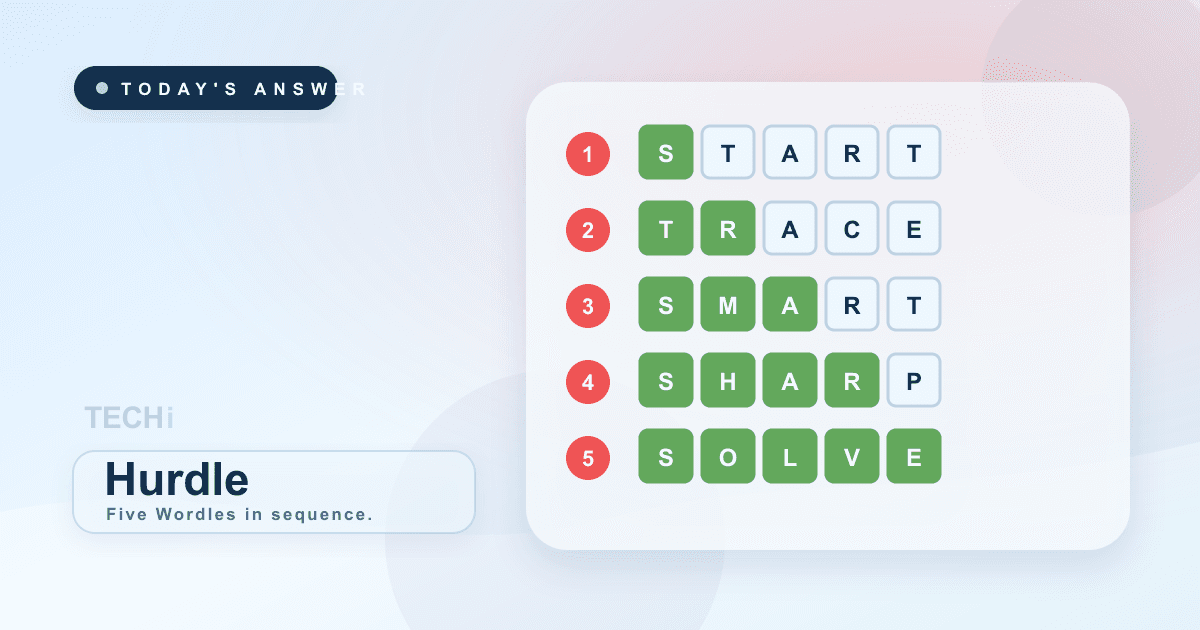

How to play Hurdle: the full guide
Hurdle is the five-in-one word game from Merriam-Webster: it stacks five Wordle-style puzzles into a single daily run, and the way they connect is what sets it apart from a plain word game. You solve four standard five-letter words, then face a Final Hurdle that ties the day together. For today's words and the walkthrough, see the Hurdle hints and answer page; this guide covers how the chain works and how to keep your streak.
What is Hurdle?
Hurdle is built on the familiar Wordle format — guess a hidden five-letter word using color feedback — but runs it five times in sequence. The twist: the answer to each hurdle becomes the first guess of the next one, and this gives the same opening information regardless of how many guesses you needed. The fifth and final round, the Final Hurdle, leans on everything the first four revealed.
How the colors work
After each guess, every tile is colored just like Wordle:
- 🟩 Green — correct letter in the correct spot.
- 🟨 Yellow — correct letter, wrong spot.
- ⬛ Gray — that occurrence is not needed; another green or yellow copy may still be required.
You get up to six guesses on each of the first four hurdles, and solving one automatically seeds its answer as guess one of the next. The fifth round — the Final Hurdle — works differently: your four earlier answers are filled in as the opening guesses, leaving just two tries to crack the last word.
Strategy for a clean run
- Protect your early guesses. Unused guesses do not transfer between rounds. Solve within the current limit, then read the carried-over answer's new colors.
- Use the carried-over word as information, not a throwaway. When the previous answer auto-fills, read its colors carefully — it's a free clue toward the new word.
- Lead with letter coverage. A strong, vowel-rich opener (SLATE, CRANE, AUDIO) does the same heavy lifting here as in Wordle: rule out or lock down as many common letters as possible early.
- Bank information for the Final Hurdle. Inspect all four prefilled words against the final answer. Colors from their original rounds do not carry over.
- Don't burn guesses chasing rare words. Stick to common five-letter words; the game's answers skew everyday, not obscure.
A few quick facts
Hurdle is free to play, refreshes once a day, and gives you a fresh five-stage run every time. The Final Hurdle leaves two new guesses. Reading its prefilled rows carefully matters more than solving earlier rounds quickly.
For today's five words and a step-by-step solve, head to the Hurdle hints and answer page, updated daily.
Questions people ask
The things readers search about Hurdle, answered plainly.
How many puzzles are in Hurdle?
Five. Hurdle stacks four standard five-letter word rounds plus a Final Hurdle into one daily run, and each solved word carries forward as the first guess of the next round.
How many guesses do you get in Hurdle?
Each round has six slots. The first starts empty; rounds two through four start with one answer prefilled, leaving five new guesses. The final round starts with four, leaving two new guesses.
What is the Final Hurdle?
The fifth round starts with the four previous answers prefilled and leaves two new guesses. These words receive fresh feedback against the final target, regardless of how quickly earlier rounds were solved.
Is Hurdle free?
Hurdle is free through Merriam-Webster’s games site, with a daily five-round challenge.
What's a good Hurdle starting word?
The same strong Wordle openers work well: vowel-rich, common-consonant words like SLATE, CRANE or AUDIO rule out the most letters early, which matters even more when five rounds depend on a fast start.
What do the Hurdle colors mean?
Green means correctly placed; yellow means present elsewhere. Gray means that occurrence is not needed, including excess copies of a repeated letter.
Tomorrow's hints, in your inbox at midnight
Daily Hurdle hints, the answer explained, and one thing worth knowing about the word — sent at midnight ET.