
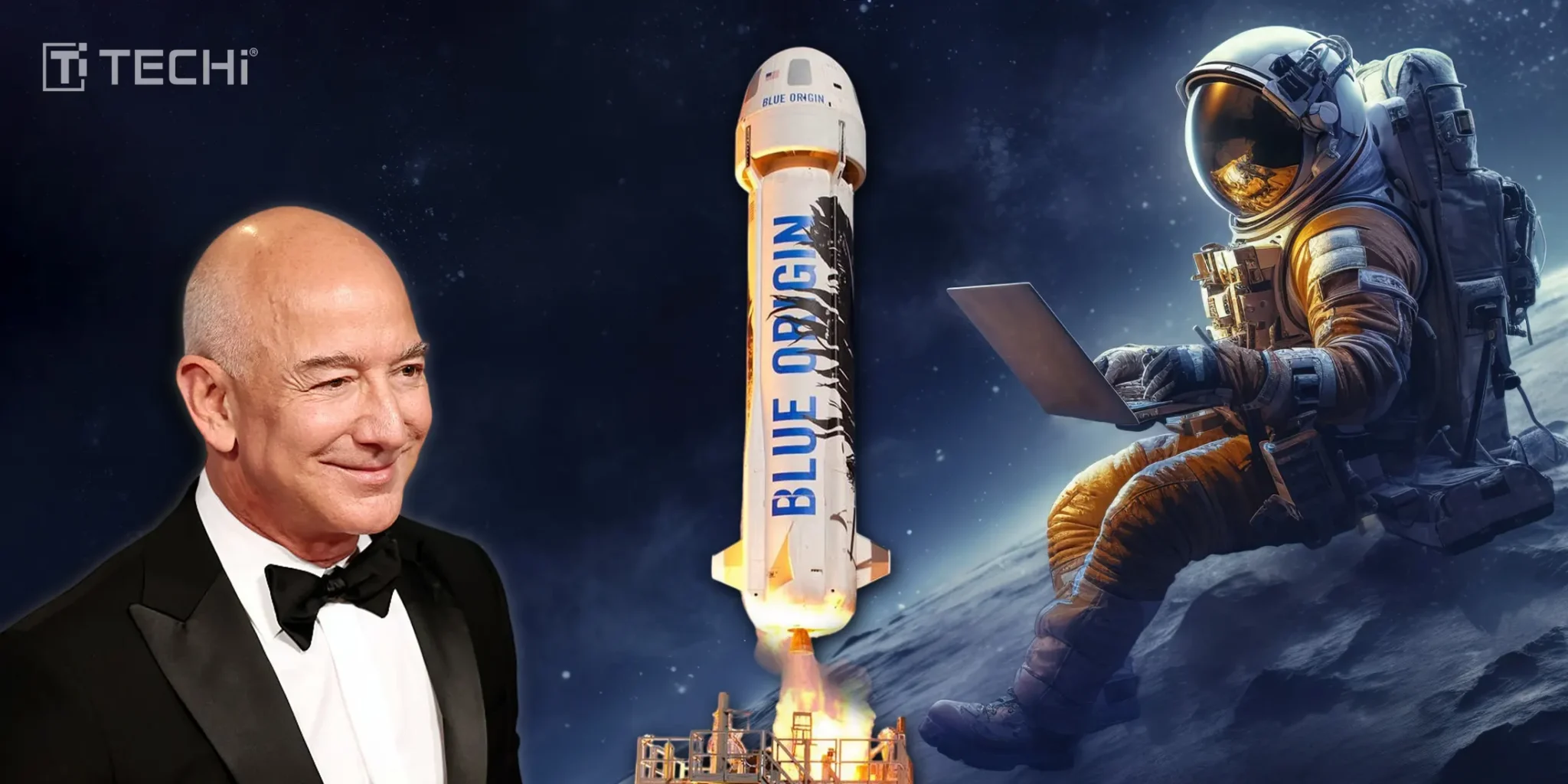
Jeff Bezos is in the news once again this week as he makes a bold prediction that millions of people will be living in space in the next several decades. Talking at the Italian Tech Week in Turin, the founder of Amazon and Blue Origin expressed confidence as well as optimism about the existence of life beyond the Earth.
From the viewpoint of Bezos, it was stated that personal desire will be the main driver to relocate to space, meaning that it will not be motivated solely by the necessity to survive or explore, but by the lifestyle and opportunity. His vision was that humans would in the future live in comfortable space colonies where robots do much of the work, and vast AI data centres will orbit above them.
Even though the vision seems to be the product of speculative fiction, Bezos spoke about it with high confidence. However, this forecast cannot be analyzed outside of the context of the competitive environment, specifically the rivalry between Elon Musk and the rival that has always existed.
Over the years, Musk has made promises to set up a colony on Mars by 2050, assuming that one million people would be allowed to live there. Instead, Bezos follows a divergent path and considers vast orbital populations and a strong human presence in near-Earth orbit, making his strategic focus different from that of Musk’s planetary agenda. Although similar ambition objectives steer both entrepreneurs, their temporal arrangements and operational systems vary, as do their ambition profiles.
Whilst these words by Bezos were made to be inspirational, they also had an effect of causing doubt. It is now incongruent, to the best of our empirical knowledge, to posit that in a few decades millions of people will be able to live in space, since even short trips to space are still rare and very expensive.
However, the belief of Bezos in the advancement of technologies cannot be mistaken. He assumes that in the future, space habitation will be viable and practical with future developments in robotics and artificial intelligence. The manual labour-intensive activities of building new habitats and repairing them would be automated, allowing humans to dedicate their efforts to creative, scientific, and cultural activities. The vision has considered space as a continuation of human civilization and not a distant frontier.
Furthermore, Bezos justified the current growth of artificial intelligence by defining it as a healthy bubble. He claimed that the AI boom was an industrial phenomenon and not a financial one, which meant that it was based on a basis of real technological progress and not speculation. To him, capital inflow leads to sustainable innovation and not a spike in hype.
This hopefulness about AI is best correlated with his general belief that the human race is entering a new stage of development, when machines and people will work to expand the spectrum of opportunities.
In the event, Bezos was able to encapsulate his viewpoint by stating that it was the best time to be excited about the future ever. The statement reflects his usual optimism, although not all stakeholders might feel this. It might be a stretch to imagine the possibility of millions of people living in space in the coming years, but it can be seen as speculative by those who are struggling to make ends meet on Earth due to poverty, housing issues and climate change. However, what Bezos is talking about is long-term strategic thinking, the theme that has been in his career.
Like how Amazon started small as an online bookstore, but now it is one of the most massive conglomerates in the world, Bezos seems to perceive the next giant leap of humanity as unavoidable, despite its current inaccessibility.
Regardless of the fulfilment of the prediction, the words of Bezos emphasise the growing competition and innovative activity in the space industry. They emphasise that such influential actors as Bezos and Musk are not just investing in launch technology but actively constructing ideas of the future of humanity in general.
At the moment, the idea of the millions of people living in space might still be a dream; however, it still provides an innovation, capital investment, and discussion that might trigger the way the second half of the century would look like.

Comments