
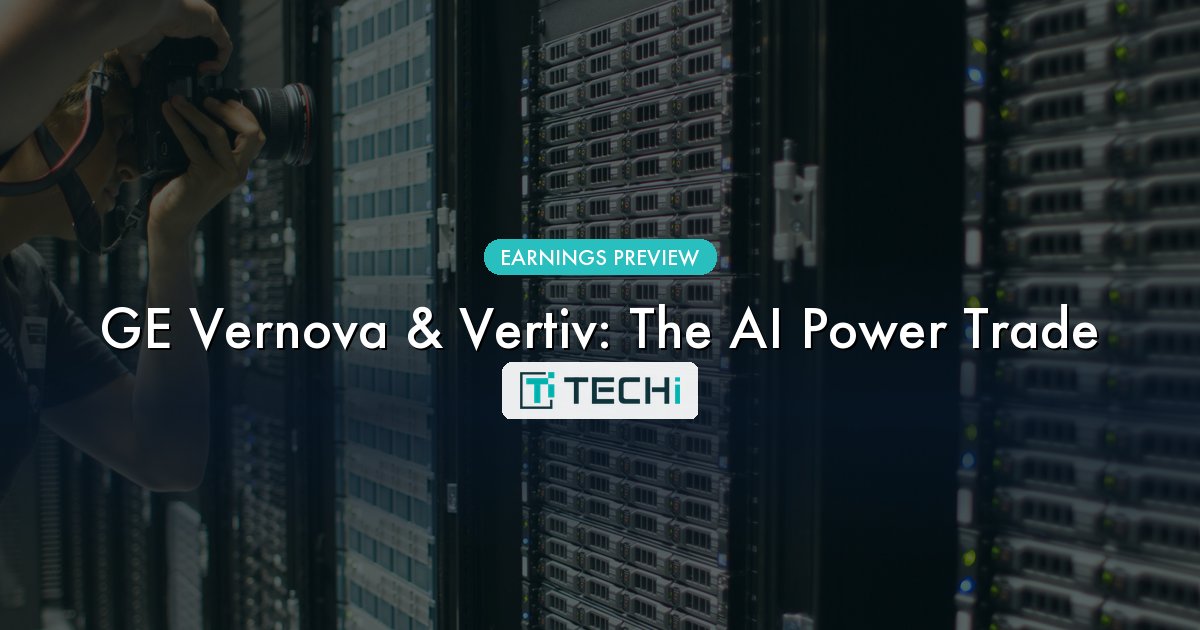
- Same Morning, Same ThesisGE Vernova (GEV) and Vertiv (VRT) both report Q1 2026 earnings before the bell on Wednesday, April 22, 2026 — GEV at 7:30 AM ET, VRT at 11:00 AM ET.
- Live TapeGEV closed Friday at $1,002.75 (up ~200% in a year). VRT closed at $307.34 (up ~42% YTD) on a reported $15B backlog.
- The Capex AnchorWall Street consensus now pegs 2026 hyperscaler capex at $527 billion. Goldman flags that consensus has been too low for two straight years — actual growth exceeded 50% against implied 20%.
- Vertiv Q1 GuideNet sales $2.5–$2.7B, adjusted EPS $0.95–$1.01. Printing to the high end with a full-year raise is the clean bull signal.
- The Pair-Trade LogicEvery AI megawatt added to hyperscaler capacity generates orders at both names — GEV supplies the electrons, VRT manages the heat. A 60/40 GEV/VRT blend captures most of the cycle upside.
Two stocks report earnings Wednesday morning, and between them they tell you more about the real economics of the AI build-out than Tesla's robotaxi slides or Alphabet's capex footnote ever will. GE Vernova (GEV) closed Friday at $1,002.75, up roughly 200% in a year. Vertiv (VRT) closed at $307.34, up about 42% year-to-date on a $15 billion backlog. Both are "pick-and-shovel" names, not AI labs, and both sit directly in the path of the capital that hyperscalers have already committed to spend. The question Wednesday answers is whether the numbers behind that spend are hitting the tape, or only the press release.
Why Wednesday's Industrial Prints Matter More Than Tesla's
GE Vernova reports Q1 2026 results before the open on Wednesday, April 22, with a 7:30 AM ET webcast from CEO Scott Strazik and CFO Ken Parks. Vertiv reports the same morning, with an 11:00 AM ET call. Having both names on the same tape is a gift for anyone trying to separate AI capex narrative from AI capex cash.
Tesla on Wednesday will drive the headlines because robotaxi is louder than gas turbines and liquid cooling. But the signal investors actually need lives in the GEV and VRT prints. If orders are accelerating, backlogs are extending, and gross margins are holding, the AI infrastructure cycle has another 12 to 18 months of visibility that the sell-side still has not fully modeled. If any of those three slip, the whole "AI capex is different this time" thesis takes a hit.
The $527 Billion Number Driving Everything
Consensus Wall Street estimate for 2026 hyperscaler capex now sits at $527 billion, up from $465 billion at the start of the Q3 2025 earnings season. That revision pattern is the part most retail investors miss. Goldman Sachs Research notes that consensus capex estimates have run too low for two consecutive years. At the start of 2024 and 2025, the Street implied 20% annual capex growth. The actual number exceeded 50% both years. If the same error repeats, 2026 capex could print closer to $700 billion, far above what any current consensus model carries.
Goldman's parallel research note on AI infrastructure projects data center power demand rising 165% by 2030. That second number is the one that matters for the pair trade here. Compute is the chip. Cooling and power are the constraints. GEV and VRT are both in the business of relieving those constraints, and neither company has ever operated in a capex backdrop remotely this generous.
GE Vernova: The Power Grid's AI Bottleneck
GE Vernova makes three things that matter for AI: gas turbines, wind turbines, and grid infrastructure. The split matters because it insulates the thesis against clean-energy policy swings. Turn down the wind book, turn up the gas book. The equipment is not interchangeable, but the engineering overhead is shared, and the customer base is the same electric utility buying the equipment to serve a new hyperscaler data center.
The stock has moved on three things in the last twelve months. First, gas turbine lead times have stretched to four and five years. That is the closest thing to pricing power in industrial equipment since the 2021 chip shortage. Second, grid orders have re-accelerated as utilities front-run the load growth tied to data center interconnect queues in Virginia, Texas, and Arizona. Third, the nuclear story. GEV's small modular reactor (BWRX-300) business is speculative today, but every major hyperscaler announcement that name-checks nuclear adds a free option to the multiple.
What Wednesday's print needs to show: orders above $12 billion in the quarter, gas equipment backlog lengthening again, and a services segment margin that holds or expands. TECHi's analysis of the $10 trillion energy rewrite walks through why the utility capex cycle is the real multi-year tailwind for GEV, regardless of which way Washington leans on subsidies.
Vertiv: Cooling the Inference Economy
Vertiv sells the boring half of the data center: power distribution, cooling, and thermal management. It is the company that keeps the rack from melting. For most of the last decade that was a low-growth industrial business with decent margins and a steady backlog. In the NVIDIA era, it became one of the highest-beta plays on AI demand, because the training runs that make headlines require cooling systems the older air-based architecture cannot support.
Liquid cooling is the product category to watch. Blackwell-class GPUs require direct-to-chip or immersion cooling to operate at nameplate power. Every new data center being designed for 2026 to 2028 opening is liquid-cooled by default, and Vertiv is one of a handful of suppliers with the scale and certifications to bid for hyperscaler projects. Its backlog sits near $15 billion, meaningfully above the company's trailing twelve-month revenue, which is the inverse of a typical capital-equipment business.
What the company already told the market for Q1 2026: net sales of $2.5 to $2.7 billion and adjusted EPS of $0.95 to $1.01. If Vertiv prints to the high end of both ranges and raises the full-year, the stock can run from $307 toward the $340 to $360 zone where the sell-side's newer models now sit. If it prints in-line and offers cautious forward commentary, the stock's 42% YTD run gives bears an easy reason to re-short.
How to Think About the Pair Trade
Most articles treat GEV and VRT as separate names in separate sectors. In practice they are two halves of the same trade. Every megawatt a hyperscaler adds to its interconnect queue eventually translates into an order at GE Vernova (to supply the electrons) and an order at Vertiv (to manage the heat that comes out the other end). The correlation is mechanical, not statistical. If a reader owns one and not the other, they are leaving half the thesis on the table.
Eaton (ETN), closed at $406.21, plays a similar role in electrical distribution but with a more diversified industrial mix. Arista Networks (ANET) at $164.23 sits on the networking side of the same build-out. The full AI-infrastructure tape is broader than GEV plus VRT, but those two are the cleanest pair for anyone trying to express a view without owning NVIDIA at 32 times forward earnings.
What Could Break This Thesis
Three risks deserve honest treatment, because they are the ones most pair-trade articles skip.
Capex discipline at the hyperscalers. Microsoft, Amazon, Alphabet, and Meta report over the next two weeks. If any one of them pulls 2026 capex guidance or signals a bending of the curve, GEV and VRT multiples compress mechanically. The single hyperscaler print that matters most for GEV's gas-turbine book is Amazon on its cloud day, because AWS has been the fastest builder. TECHi's coverage of Amazon stock and AWS lays out why the capex-to-revenue ratio is the line to watch.
Execution risk. Both GEV and VRT sell complex equipment with long manufacturing lead times, and both are already stretched. A quality miss, a supply-chain disruption, or a missed delivery in a flagship hyperscaler project has a disproportionate effect on the tape, because it feeds directly into sell-side questions about whether these companies can actually deliver what the backlog implies.
Valuation. GEV trades at elevated multiples by the only framework that matters for an industrial: replacement cost. A company with a 200% one-year return carries less margin for error than one that has simply kept up with the S&P. Vertiv at 40-plus times forward earnings is priced for flawless execution. Neither is a value stock. Both are growth-at-a-reasonable-price stories only if the earnings revisions keep trending up.
The $10,000 Question
Here is the real question. An investor with $10,000 and a three-year horizon has three ways to express the AI-infrastructure trade: own NVIDIA directly, own the hyperscaler that buys from NVIDIA, or own the companies that pour power and cooling into the buildings NVIDIA chips go into. The third option is the one the market still under-owns relative to its earnings growth rate.
A 60-40 split between GEV and VRT, rebalanced once per year, is the cleanest way to express the pair trade at current prices. The case for weighting GEV slightly higher is duration. Gas-turbine orders taken in 2026 generate revenue into 2029 and 2030. Vertiv's cycle is shorter and more rate-sensitive because liquid-cooling orders convert to revenue in quarters, not years. In a soft-landing scenario, VRT outperforms. In a longer AI cycle where the backlog keeps extending, GEV compounds harder. A 60-40 blend captures most of the upside in both.
None of this works if Wednesday's prints are soft. That is the honest part of the thesis. Two companies, two conference calls, one morning. The rest of the tape rotates around those numbers.
Related reading on TECHi: The $10 Trillion Energy Rewrite · NVIDIA Stock Analysis · Amazon Stock & AWS · NVIDIA vs Tesla · Apple at $3.97 Trillion.
FAQ
Frequently asked questions
When do GE Vernova and Vertiv report Q1 2026 earnings?
Both report on the same day, Wednesday, April 22, 2026, before the US market opens. GE Vernova hosts a 7:30 AM ET webcast led by CEO Scott Strazik and CFO Ken Parks. Vertiv holds its earnings call at 11:00 AM ET. Same-day reporting from two core AI-infrastructure names is unusual and makes that single morning of tape one of the most consequential reads on the AI capex cycle all quarter.
What has Vertiv guided for Q1 2026?
Vertiv guided Q1 2026 net sales of $2.5 billion to $2.7 billion and adjusted EPS of $0.95 to $1.01 when it last updated the market. Printing to the high end of both ranges and raising the full-year would be the clean bull signal. In-line numbers with cautious forward commentary would test the stock's 42% year-to-date rally.
Why are GEV and VRT considered AI infrastructure stocks?
Neither company makes chips or models. Both supply the physical infrastructure AI depends on. GE Vernova sells gas turbines, wind turbines, and grid equipment to utilities serving hyperscaler data centers. Vertiv sells power distribution, liquid cooling, and thermal management systems installed inside those data centers. Every megawatt added to hyperscaler capacity passes through both their order books.
Is the $527 billion hyperscaler capex number real?
Yes. That is the consensus estimate Wall Street has coalesced around for 2026, up from $465 billion at the start of the Q3 2025 earnings season. Goldman Sachs Research flags that consensus capex numbers have run too low for two years in a row. Actual capex growth exceeded 50% in both 2024 and 2025 against implied 20% estimates, suggesting $600B to $700B is plausible if the same revision pattern repeats.
How do GEV and VRT compare to owning NVIDIA?
Ownership of NVIDIA expresses direct semiconductor exposure to AI compute. GEV and VRT express the capital-equipment side of the same build-out. Historically NVIDIA has compounded faster, but at 32 times forward earnings the multiple is elevated. GEV and VRT are growth-at-a-reasonable-price plays in a space where the backlogs are as long as the visibility allows. Most balanced AI portfolios own both layers.
What is the biggest risk to this thesis?
Hyperscaler capex discipline. Microsoft, Amazon, Alphabet, and Meta report over the next two weeks. Any one of them cutting 2026 capex guidance or signaling a plateau would compress GEV and VRT multiples fast. Execution risk on flagship hyperscaler projects and elevated current valuations are the other two meaningful risks.

Disclaimer
This article is for informational purposes only and does not constitute financial, investment, tax, or legal advice. Market data, tax rules, and prices can change after the article date. TECHi and its authors may hold positions in securities or digital assets mentioned. Always conduct your own research and consult a licensed financial, tax, or legal professional before making decisions.
About the Author
Jazib ZamanJazib Zaman founded TECHi in 2010 and is chief executive of its publisher, TechAbout LLC. He is a former member of the Forbes Technology Council. His TECHi writing covers AI infrastructure, semiconductor businesses and the financial tradeoffs of adopting new technology. His published work includes company earnings and valuations, AI software costs, and the effect of technology investment on public markets.


Comments