
- The moveLumentum closed July 9 at $794.30, up 12.33% — about eight times the Nasdaq's gain — and is up roughly 115% in 2026.
- The businessLasers, 1.6T optical transceivers and optical circuit switches: the bandwidth layer AI clusters need before the first model trains.
- The numbersMarch-quarter revenue hit a record $808.4 million, up 90% year over year, with guidance to $960M–$1.01B — another all-time record at the midpoint.
- The triggerA leaked Meta memo doubling next year's compute target to 14 gigawatts — proof that every compute announcement is now a bandwidth order.
- The riskHyperscaler concentration, a supply-gated OCS ramp, 13.2% short interest and a valuation with no floor if 90% growth merely normalizes.
The best-performing corner of the 2026 AI trade does not fabricate a single transistor. Lumentum Holdings — a maker of lasers, optical transceivers and light-based switches — closed Thursday, July 9 at $794.30, up 12.33% on the day, roughly eight times the Nasdaq's gain. From its December 31 close of $368.59, the stock has returned about 115% this year. And Thursday's catalyst was not Lumentum news at all: it was a leaked Meta memo about someone else's chips. That is the tell about what this company has become — a derivative on every gigawatt of AI compute announced anywhere, by anyone.
The wires of the AI era are made of glass
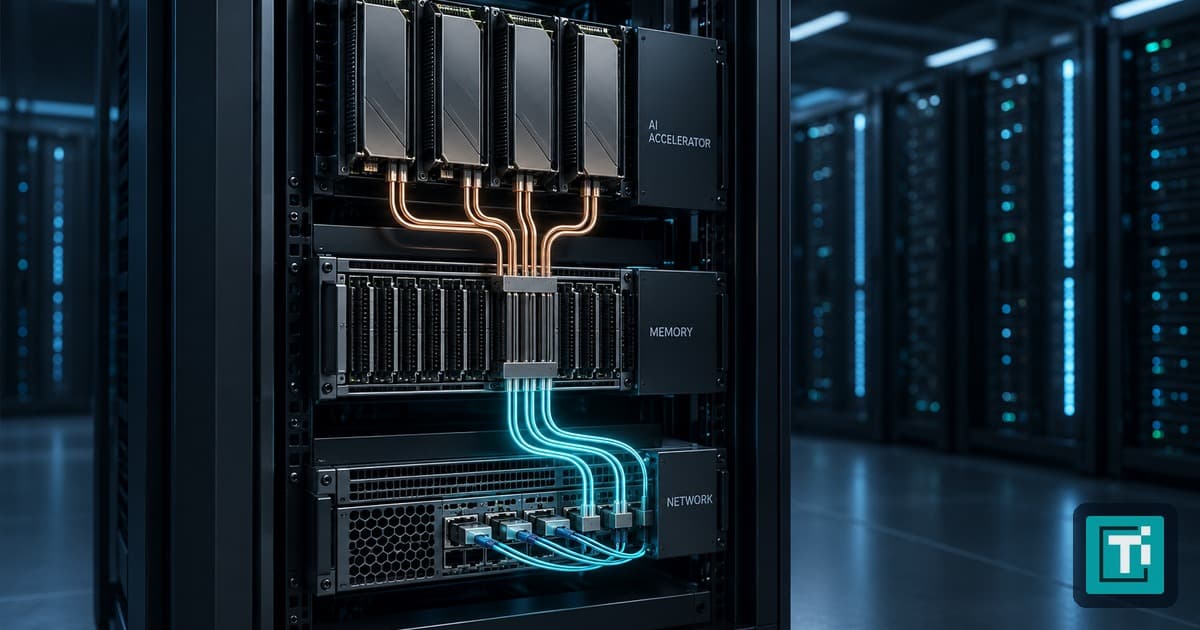
Lumentum sells the connective tissue of AI data centers: laser chips, the 1.6-terabit optical transceivers that carry traffic between GPU racks, and optical circuit switches — devices that route signals with steered light instead of electrical packet switching, saving power and latency at cluster scale. As AI clusters grow from thousands of accelerators to hundreds of thousands, the scarce resource stops being compute and becomes the bandwidth between compute. Every additional gigawatt of accelerators needs optical ports before the first model trains.
The rest of the industry has been endorsing that thesis with money. Marvell paid $3.25 billion for Celestial AI's photonics to get deeper into the same layer, and cloud transceiver shipments at Lumentum rose more than 40% sequentially last quarter with the 1.6T ramp just starting.
The numbers behind the double
The stock's 2026 run sits on an income statement, not a story. In its March quarter, Lumentum reported record revenue of $808.4 million, up 90% year over year, with gross margin up 540 basis points sequentially, operating margin up 700, and non-GAAP earnings of $2.37 per diluted share. CEO Michael Hurlston credited mix — laser chips, plus what he called the "less-heralded" scale-across components like pump lasers and narrow linewidth assemblies.
Guidance extends the slope. For the June quarter, management guided revenue to $960 million–$1.01 billion with 35–36% non-GAAP operating margin and $2.85–$3.05 in earnings per share — a midpoint Hurlston called "another new all-time quarterly revenue record." The detail worth underlining: the two growth drivers management talks about most, optical circuit switches and co-packaged optics, are still barely contributing. The OCS ramp — tied to a multi-year, multi-billion-dollar purchase agreement — is what Hurlston calls "probably our biggest ramp," and it is currently gated by supply, not demand. Revenue grew 90% before the headline products kicked in. Capacity is being built to match: a four-quarter pump-laser expansion at Rose Orchard and a newly acquired Greensboro, North Carolina fab converting to indium phosphide, targeted online in early 2028.
Thursday's trigger came from Menlo Park
The session's fuel was a leaked Meta memo showing the company plans to expand its overall computing power to 14 gigawatts next year — roughly double — alongside confirmation that its custom AI chip enters production in September. MARA Holdings buying a Texas data-center site with up to 2 gigawatts of capacity added to the pile. None of this mentions Lumentum. All of it is future demand for optical interconnect, which is the point: in 2026, a compute announcement is a bandwidth order announcement. Meta's in-house chip is a Broadcom co-designed rival to Nvidia's accelerators — and photons do not care whose accelerator they connect.
The violence cuts both ways
A stock that doubles on infrastructure enthusiasm also trades like it. Even after Thursday's 12% jump, Lumentum sat 11.3% below its 50-day moving average — the scar of early July's photonics selloff — while holding 42% above its 200-day. Short interest stands at 13.2% of the float. This is the highest-beta expression of AI infrastructure on the board: it reprices violently in both directions, on other companies' news.
The risks are equally structural. Revenue concentrates in a handful of hyperscalers whose capex decisions can turn on one board meeting. The biggest ramp is supply-gated, which converts backlog into a promise with execution risk attached. And a valuation built on 90% growth has no obvious floor if the growth rate merely normalizes — the dynamic TECHi flagged across the AI hardware complex when Sandisk, Micron, AMD and Applied Optoelectronics showed the new risk in AI stocks this spring.
What to watch
- The August print. The June quarter needs to land inside the $960 million–$1.01 billion guide for the re-rating to hold; the midpoint is the record Wall Street now assumes.
- OCS supply. The biggest ramp is gated by components, not customers — any commentary on the bottleneck clearing moves the multi-year number forward.
- Hyperscaler capex season. Meta, Microsoft, Google and Amazon guide the spending that becomes Lumentum's bookings; the leaked 14-gigawatt memo gets its official test when Meta reports.
- The picks-and-shovels pair. Lumentum monetizes the bandwidth layer the way Lam Research monetizes the fab layer — the two toll booths TECHi covered this week sit on the same highway, and they will crack on the same capex cut.
For two years the AI trade priced compute. In 2026 the market is discovering that compute is easy to announce and hard to connect. Lumentum's double is that discovery, marked to market — and Thursday it repriced again on a memo about somebody else's chips.
FAQ
Frequently asked questions
What does Lumentum do?
Lumentum makes lasers, optical transceivers and optical circuit switches — the components that move data between GPUs and racks inside AI data centers — plus industrial lasers. Its growth is driven by cloud and AI interconnect demand.
Why did Lumentum stock jump on July 9, 2026?
LITE rose 12.33% to $794.30 amid a fiber-optics rally sparked by a leaked Meta memo showing plans to double computing power to 14 gigawatts next year, alongside Meta's custom AI chip entering production in September.
How much is Lumentum stock up in 2026?
From its December 31, 2025 close of $368.59 to the July 9, 2026 close of $794.30, Lumentum has gained roughly 115% year to date.
When does Lumentum report earnings next?
Fiscal fourth-quarter results are expected in August 2026. Management guided June-quarter revenue to $960 million–$1.01 billion with non-GAAP EPS of $2.85–$3.05 — a new record at the midpoint.

Disclaimer
This article is for informational purposes only and does not constitute financial, investment, tax, or legal advice. Market data, tax rules, and prices can change after the article date. TECHi and its authors may hold positions in securities or digital assets mentioned. Always conduct your own research and consult a licensed financial, tax, or legal professional before making decisions.
About the Author

Umair Aslam is a finance executive and markets writer at TECHi. He completed INSEAD's Management Acceleration Leadership Program in executive education in 2025. His published analysis covers public companies, AI infrastructure and semiconductors, including earnings, financing requirements, valuations and stock comparisons.
Comments