

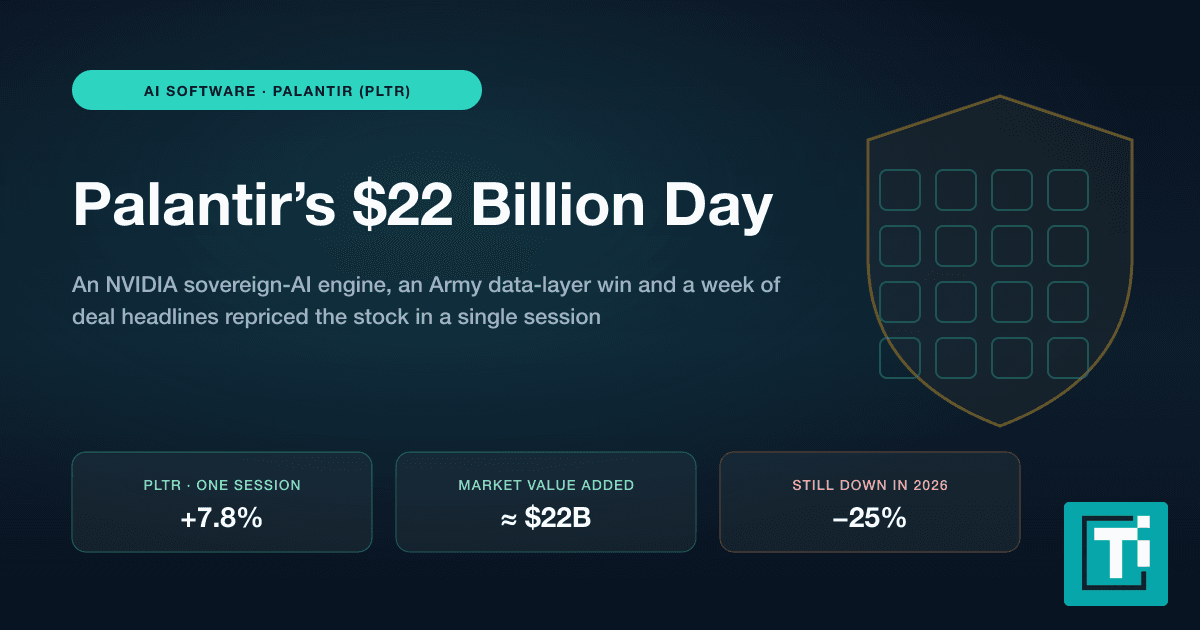
Palantir Technologies closed near $124.57 on Wednesday, July 22, down roughly 6% and briefly trading as low as $123.45 before the session ended. A single day rarely decides much, and this one landed on a stock already down about 21% in 2026, so the drop reads more like frayed nerves than a verdict. What makes it worth slowing down for is not the size of the move. It is that three unrelated headlines arrived within hours of one another, and each pushed on the same quiet assumption.
British regulators questioned how the National Health Service has been describing results from its Palantir-run data platform. A developer uploaded a free, open-source intelligence tool to GitHub. And a fresh wave of valuation commentary circulated twelve days before the company reports second-quarter earnings. On their own, none of these reprices a company worth nearly $300 billion.
Stacked together, they prod the same soft spot. Palantir trades near 40 times sales because the market has agreed to treat its moat — a proprietary data ontology and years of accumulated government trust — as close to unassailable. Each of Wednesday's stories quietly asked whether that is still true. The company's rally three weeks earlier on the NVIDIA sovereign-AI deal leaned on exactly that moat narrative; this week poked at it from the other side.
- The movePalantir closed near $124.57 on July 22, down about 6% and touching $123.45 intraday, on a stock already down roughly 21% in 2026.
- The triggersThree same-day headlines: U.K. regulators questioning NHS reporting of Palantir's data platform, a free open-source tool on GitHub, and valuation nerves before earnings.
- The through-lineNone is fatal alone; together they test whether Palantir's moat — proprietary ontology plus government trust — justifies a price near 40 times sales.
- The open-source caveat"World Monitor" is a GitHub project, not a production competitor. It dents the pricing-power narrative, not Palantir's market share.
- What settles itQ2 earnings land August 3. The Street expects about $1.81 billion in revenue, up ~81% year over year — but the texture matters more than the headline.
A trust question wearing an NHS badge
The most concrete of the three came out of Britain. The U.K.'s Office for Statistics Regulation weighed in on public concern about how NHS England has communicated performance data from its Federated Data Platform — the Palantir contract valued at hundreds of millions of pounds, and the company's largest healthcare deal anywhere. The regulator did not ask for the contract to be torn up. What it flagged was subtler: NHS England had to bolt disclaimers onto its own analysis, conceding it "cannot therefore draw conclusions about cause and effect as other variables have not been controlled for."
Read narrowly, that is a methodology note. Its weight comes from the address. Palantir's international healthcare pitch rests on the Federated Data Platform working as a showcase — proof that one vendor can knit a fragmented health system's data together and demonstrate results a health minister can point to. When the national statistics regulator questions how those results are described, and when critics such as the Good Law Project's Jo Maugham argue the company "never has been" one "that can be trusted with this nationally important contract," the damage is not to this quarter's revenue. The contract stands. The damage is to the reference itself.
That distinction is not academic for a shareholder. Palantir's entire land-and-expand model in government depends on one flagship deployment becoming the argument for the next. Greater Manchester's integrated care board had already declined the platform in favor of systems built with U.K. universities and local firms — a small but pointed reminder that the trust Palantir sells is granted locally and can be withheld locally. A moat made of institutional confidence widens when a marquee client vouches for you and narrows when a regulator makes that client add a footnote.
The same logic travels well beyond healthcare. Palantir's defense and intelligence business rests on the premise that the most guarded institutions trust it with their most sensitive data, and that trust is the part of the moat no competitor can simply copy. Anything that makes a flagship civilian deployment look like a cautionary tale, however unfairly, nudges up the cost of the next sale. That is how a British statistics footnote ends up moving a U.S.-listed stock by six percent in an afternoon.
What "World Monitor" actually is — and what it isn't
The second story is the easiest to overstate, so precision matters. A developer released a free tool called World Monitor on GitHub. By the accounts of the people who looked at it, it "does not compete at the enterprise scale" and is "a GitHub project, not a live production service." In any functional sense it is not a Palantir rival, and pretending otherwise would be its own kind of error.
What it bruised was the story, not the market share. Palantir charges premium prices on the argument that consolidating messy, sensitive data securely is genuinely hard and genuinely proprietary. A weekend repository does not disprove that. But its existence invites the one question the company would rather investors not sit with: how much of the moat is technology, and how much is trust and inertia?
This is the mechanism worth understanding, because it is where AI economics keep ambushing incumbents. Open, good-enough tooling does not have to match a leader feature-for-feature to compress the premium that leader charges. It only has to make a procurement officer ask why the proprietary option costs what it does. The threat to a 40-times-sales stock is almost never a same-day replacement; it is the slow erosion of pricing power as buyers gain a credible reference point for "free." We raised a version of this when we audited how much of Palantir's growth is genuinely AI-driven; the same discipline applies to the moat, which is easy to assert and hard to measure.
There is precedent worth holding in mind. Proprietary databases, mapping stacks and analytics suites have all watched open alternatives grind down their pricing power over the past two decades, rarely by capturing the flagship accounts and almost always by resetting what buyers believe the work should cost. Palantir may be genuinely different: its security certifications and deployment muscle are not reproduced in a weekend repository. But the market's task on a nervous Wednesday is to price the risk that it is not different enough, and that is precisely what it did.
Why a 6% day cuts deeper at 40 times sales
Valuation is the amplifier under all of it. Palantir trades around 40 times forward sales and richer than 60 times on a trailing basis, with a forward price-to-earnings multiple near 90 and a trailing one well above 140 — against a software-industry average closer to the high 20s. Numbers that stretched leave no slack. A stock priced for flawless execution reacts to a trust wobble and a perception dent the way a taut rope reacts to a tug.
The technical picture on Wednesday matched the mood. Shares slid toward chart support near $123, momentum readings pushed toward oversold, and by most reads a genuine recovery needs a close back above roughly $130. None of that is a fundamental crack. It is a description of how little forgiveness a stock at this multiple earns on a bad-news day — and it is why the same worry that drove insider-selling warnings earlier in 2026, when sizable disposals sat awkwardly against the price, keeps resurfacing. The business can be excellent and the stock can still be expensive; those two facts have coexisted in Palantir for most of the year.
August 3 is where the argument gets settled
Everything above is prologue to one date. Palantir reports second-quarter results on Monday, August 3, after the U.S. close, with a webcast at 5:00 p.m. Eastern. Wall Street is looking for about $1.81 billion in revenue, up roughly 81% year over year, and earnings near $0.33 a share against $0.16 in the same quarter last year. Those are not the numbers of a business in trouble. They are the numbers the multiple already assumes.
So the print itself will matter less than its texture. The lines that decide whether Wednesday was noise are the growth rate in U.S. commercial revenue, the pace of new government bookings, how aggressively existing customers are expanding, and whether management raises full-year guidance rather than merely clearing it. A beat on headline revenue paired with softening commercial acceleration would hand the skeptics their case. An acceleration with a raised outlook would make the moat argument look, once again, like the correct one. The first-quarter report set a demanding bar on exactly these lines, and the market has spent the months since deciding whether that pace was a peak or a floor.
Two figures beneath the headline will carry unusual weight this time. Net dollar retention shows whether the customers Palantir already has are spending more, the cleanest evidence that the platform compounds value rather than merely landing logos. Commercial customer count, especially in the United States, signals whether the AIP bootcamp motion is still turning curiosity into signed contracts. Real strength on both lines would answer the open-source worry far more convincingly than any statement the company could put out.
Separating the signal from the mood
Here is the honest read, with its own escape hatch. If August 3 delivers accelerating commercial growth and a raised outlook, this week looks like a mood swing, the NHS and open-source stories fade to footnotes, and the moat narrative reasserts with a cheaper entry price attached. If growth cools, or government momentum stalls while the trust questions linger, then a stock at 40 times sales has a very long way to fall and Wednesday was the first honest tell.
What would disprove the bearish case is easy to name: a clean quarter that reaccelerates the commercial engine and lifts guidance. What would confirm it is just as clear: deceleration, or a beat that leans on government lumpiness rather than durable expansion. Until the numbers arrive, the market has repriced a mood rather than a fundamental — and those are not the same thing, which is exactly why the Palantir-versus-Oracle debate keeps returning to durability over any single quarter. A 6% Wednesday is a data point. August 3 is the argument.
FAQ
Frequently asked questions
Why did Palantir stock fall on July 22, 2026?
PLTR closed near $124.57, down about 6%, as three concerns hit the same day: U.K. regulators questioned how NHS England reports results from Palantir's Federated Data Platform, a free open-source intelligence tool appeared on GitHub, and valuation commentary circulated ahead of earnings. None is fatal alone, but together they pressured a stock trading near 40 times sales.
Is "World Monitor" a real competitor to Palantir?
Not in any functional sense. World Monitor is a free GitHub project, described by observers as not competing at enterprise scale and not a live production service. Its impact is on the narrative around Palantir's pricing power, not on its market share.
When does Palantir report Q2 2026 earnings?
Monday, August 3, 2026, after the U.S. market close, with a webcast at 5:00 p.m. Eastern. Analysts expect about $1.81 billion in revenue, up roughly 81% year over year, and earnings near $0.33 per share against $0.16 a year earlier.
How expensive is Palantir stock?
Very, by conventional measures. PLTR trades around 40 times forward sales and near 90 times forward earnings, against a software-industry average closer to the high 20s. That leaves little room for disappointment, which is why relatively small news moved the stock so much.
What should investors watch on August 3?
The texture beneath the headline: U.S. commercial revenue growth, net dollar retention, government bookings, and whether management raises full-year guidance. Strength there would support the moat argument; deceleration would validate the week's concerns.

Disclaimer
This article is for informational purposes only and does not constitute financial, investment, tax, or legal advice. Market data, tax rules, and prices can change after the article date. TECHi and its authors may hold positions in securities or digital assets mentioned. Always conduct your own research and consult a licensed financial, tax, or legal professional before making decisions.


Comments