
TECHi comparison graphic: Oracle as AI cloud capacity landlord versus Broadcom as custom silicon toll road.
Oracle and Broadcom are now chasing the same AI infrastructure budget, but they are not selling the same thing. Oracle is trying to rent scarce AI capacity like long-duration cloud real estate. Broadcom is trying to collect a toll whenever a hyperscaler decides a workload deserves custom silicon, custom networking, or both. That makes this comparison more useful than another generic “best AI stock” screen.
The tape already shows the market treating them as two different scarcity trades. ORCL quote showed Oracle at $223.30, up 9.62%, as of May 29, 2026, 3:30 PM EDT, while AVGO quote showed Broadcom at $439.02, up 2.92%, as of May 29, 2026, 3:34 PM EDT. The same TECHi snapshots put Oracle’s next-session model signal at Buy with an expected +3.9% move, and Broadcom’s at Buy with an expected +1.6% move. That is not a trading command. It is a clean read on where the near-term setup is tilted before Broadcom’s June 3 print and Oracle’s June 10 print.
- The cleaner headline is not “cloud vs chips.”Oracle is selling scarce AI capacity; Broadcom is selling the custom silicon and Ethernet plumbing that can make that capacity cheaper, faster, and more workload-specific.
- Oracle has the bigger backlog storyThe bull case is that massive AI demand lets Oracle act like an AI cloud landlord. The risk is that leases, financing and capex move faster than recognized cloud revenue.
- Broadcom has the better cash profileBroadcom’s AI revenue is accelerating and its free cash flow is already visible. The risk is customer concentration and the lumpiness of hyperscaler custom-chip ramps.
- The next two catalysts are immediateBroadcom reports first, on June 3 after the close. Oracle follows on June 10. Together, they will test the two most important AI infrastructure models in public markets.
- One-year viewA 12-month investor should not chase either stock only because “AI infrastructure” is hot. The better framework is capacity-risk exposure in ORCL versus concentration-risk exposure in AVGO.
The money layer changed
Oracle’s latest official setup is not subtle. In Oracle Q3, the company reported $553 billion of remaining performance obligations, 84% growth in cloud infrastructure revenue to $4.9 billion, and a plan to raise up to $50 billion in debt and equity financing. That is not a normal software story. It is an AI capacity balance-sheet story.
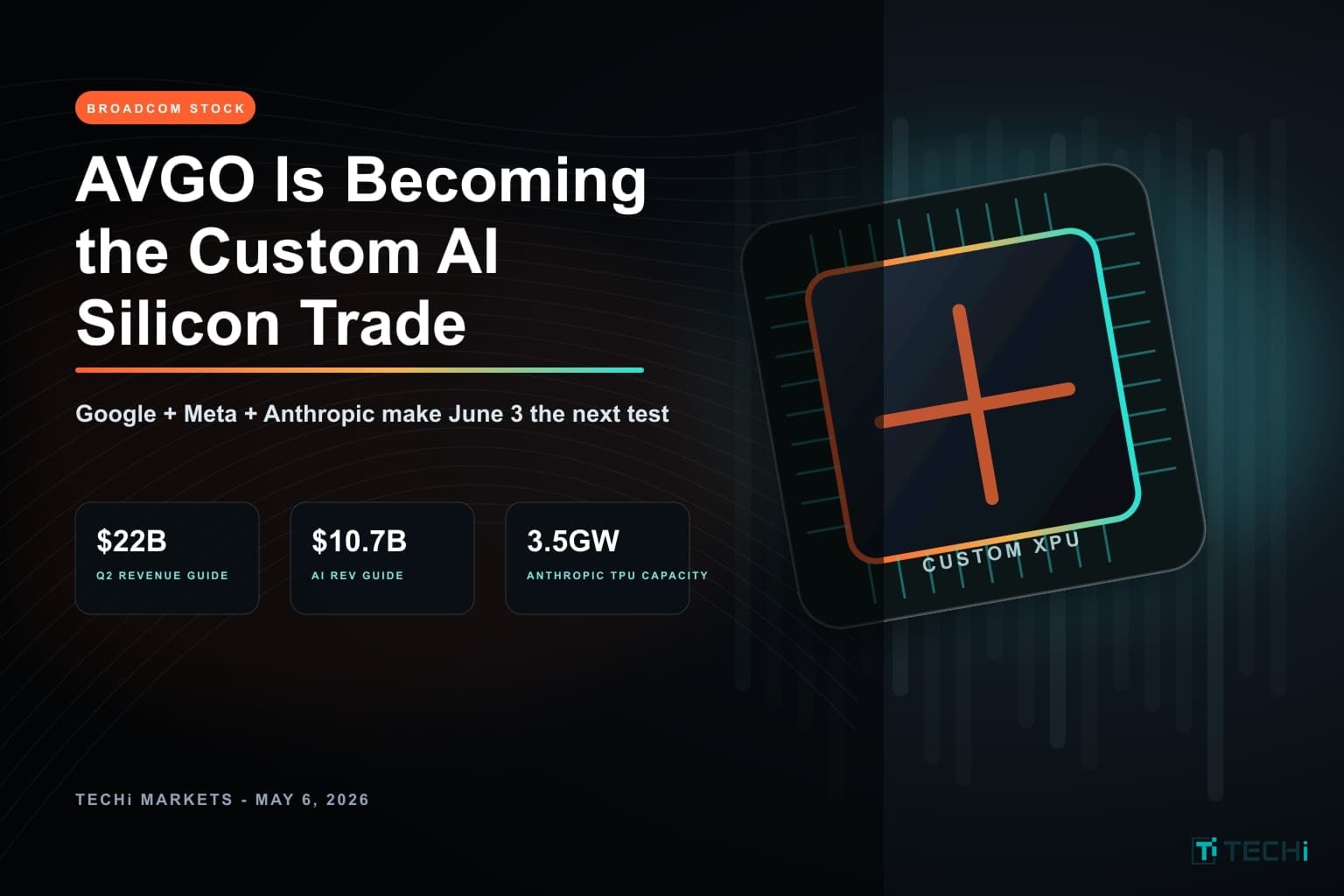
Broadcom’s version is almost the mirror image. In Broadcom Q1, the company reported record quarterly revenue of $19.3 billion, said AI revenue grew 106% to $8.4 billion, guided Q2 revenue to about $22 billion, and produced $8.01 billion of free cash flow. That is not a generic chip-cycle story. It is a toll-road story with cash already coming through the booth.

Diagram showing how Oracle and Broadcom monetize different layers of the AI infrastructure stack.
Oracle’s landlord thesis is bigger, but less forgiving
The bullish case for Oracle is that AI customers need capacity faster than the largest clouds can supply it. OpenAI said its expanded Oracle partnership adds 4.5 gigawatts of U.S. Stargate capacity, bringing more than 5 gigawatts under development, and the Stargate update also said the capacity would run more than 2 million chips. That is the landlord version of AI infrastructure: secure the power, buildings, chips and network; then rent the scarce compute layer to customers with urgent demand.
The problem is timing. Oracle’s Oracle filing shows $39.2 billion of cash used for capital expenditures in the first nine months of fiscal 2026, $48.25 billion of trailing four-quarter capex, negative $24.74 billion of trailing four-quarter free cash flow, and $261 billion of additional lease commitments tied substantially to data-center arrangements. Those numbers do not kill the thesis. They define it. Oracle has to prove that backlog converts before the financing stack becomes the story.
That is why TECHi’s earlier TECHi preview framed Oracle’s June 10 report around OCI backlog, capex, cloud margin, debt and lease risk rather than a simple EPS beat. The same issue appears in ORCL financials, where the balance-sheet view highlights debt/equity and current-ratio context alongside statement history. Investors should treat those pages as the control panel for the landlord thesis, not as background tabs.
The Street is still leaning positive. ORCL forecast shows a Buy consensus, a $244.03 average target, a 79% buy-or-strong-buy weight, and a 4.10 rating score. But Oracle’s upside is no longer just about being “right on cloud.” It is about being right on cloud at the exact moment the company is signing longer leases, raising capital and expanding capacity.
The enterprise angle matters too. Oracle’s own OCI paper positions OCI as an integrated AI stack for training, inference, apps and customer data. Its Zettascale10 announcement goes further, describing multi-gigawatt clusters, the Abilene Stargate fabric and target deployments of up to 800,000 NVIDIA GPUs. That is why Oracle is not merely trying to catch AWS or Azure. It is trying to be the AI capacity landlord for customers that care more about access than cloud religion.
Broadcom’s toll road is narrower, but cleaner
Broadcom is not trying to own the cloud campus. It wants to sit inside every serious custom AI campus. Its April April filing says Broadcom will develop and supply future Google TPU generations and provide networking and other components for next-generation AI racks through up to 2031. The same filing says Anthropic will access about 3.5 gigawatts of next-generation TPU-based AI compute capacity through Broadcom starting in 2027, dependent on Anthropic’s commercial success.
That last qualifier matters. Broadcom’s advantage is not magic; it is engineering leverage attached to customer-specific demand. The customer list is powerful, but the timing is still controlled by hyperscaler deployment calendars. The Broadcom filing says Broadcom’s top five end customers accounted for about 50% of quarterly revenue and warns that large AI and wireless orders can make revenue fluctuate. This is the concentration risk investors get in exchange for a high-quality toll-road position.
Still, the cash profile is hard to ignore. AVGO financials shows Q1 FY2026 revenue of $19.31 billion, operating cash flow of $8.26 billion, capital expenditure of only $250 million, and free cash flow of $8.01 billion. Oracle spends before the revenue shows up. Broadcom, at least right now, is getting paid while the buildout is still under construction.
The product roadmap is also broader than one customer. Broadcom and Meta announced a multi-year MTIA partnership in which the initial commitment exceeds 1 gigawatt, and the Meta deal says Broadcom will work across chip design, advanced packaging and Ethernet networking through 2029. OpenAI separately announced a 10-gigawatt custom accelerator collaboration with Broadcom, and the OpenAI deal says Broadcom’s networking systems are part of the rack deployment plan. Anthropic’s Anthropic note confirms multiple gigawatts of next-generation TPU capacity expected to come online starting in 2027.
That is why the newer AVGO setup is best read as a customer-breadth test, not just an earnings setup. AVGO forecast shows a Buy consensus, 46 analysts tracked, 93% buy-or-strong-buy weight and a $480.49 average target. The valuation is demanding, but the market is paying for Broadcom’s right to tax custom silicon, Ethernet and AI rack complexity.
The peer sets tell you the real difference
Oracle’s comparison set is cloud and enterprise software. ORCL peers currently frames the public cohort around Microsoft, CrowdStrike and ServiceNow, which makes sense for a database-and-cloud platform trying to win enterprise AI workloads. Broadcom’s comparison set is semiconductor infrastructure. AVGO peers puts it beside Nvidia, Micron, AMD, Intel, Texas Instruments, Qualcomm, Analog Devices and Marvell. That difference is the whole article in one screen: Oracle is judged on capacity utilization and software economics; Broadcom is judged on chips, networking and customer ramps.
The news feeds point the same way. ORCL news is now dominated by Oracle’s AI cloud and earnings-capex question, while AVGO news collects Broadcom’s AI customer and custom silicon trail. Investors who lump both into “AI infrastructure” miss the more useful distinction: Oracle carries asset-and-financing risk; Broadcom carries customer-concentration and execution-timing risk.

Four-part investor checklist for Oracle backlog conversion, Broadcom customer breadth, cash timing and margin durability.
One-year view: own the bottleneck, not the slogan
For the next 12 months, Oracle is the higher-beta capacity bet. If OCI revenue keeps accelerating, customer prepayments keep reducing capital at risk, and June 10 reinforces the $90 billion FY2027 revenue path, Oracle can keep re-rating as a scarce-capacity cloud landlord. If capex rises again without cleaner funding commentary, the stock can give back a lot of the “AI landlord” premium quickly. ORCL earnings is the right page to watch because the next report has to answer backlog conversion, not merely EPS.
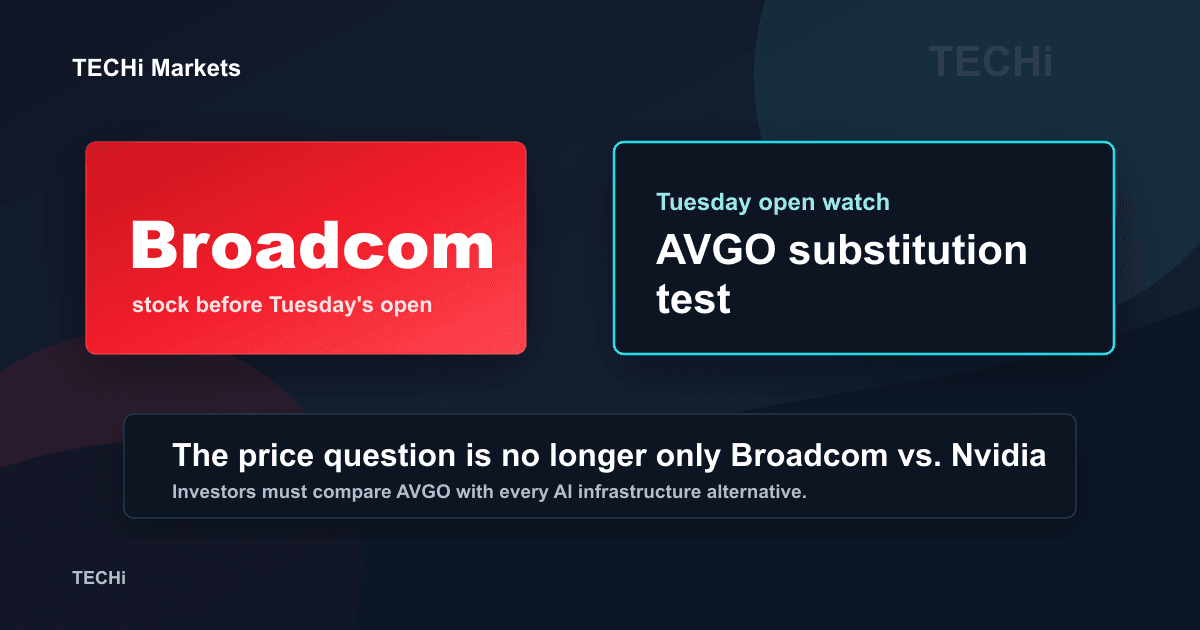
Broadcom is the cleaner compounder if custom silicon keeps broadening beyond the largest early customers. Its near-term hurdle is June 3, where investors need AI semiconductor revenue, networking mix and customer breadth to support the current multiple. AVGO earnings is the correct dashboard for that print because the key question is whether the Q2 guide and design-win commentary confirm that Broadcom is more than a one-cycle beneficiary of hyperscaler panic buying.
A recent T. Rowe analysis of AI infrastructure stocks captured the broader tension: earnings growth is exceptional, but investors are still testing whether capex sustainability deserves a permanently higher multiple. That is exactly why this pair is useful. Oracle answers the question from the asset side. Broadcom answers it from the component side.
Next-session map: do not chase both the same way
For the next trading session, the cleaner tactical read is that Oracle has more momentum torque and more headline risk, while Broadcom has the closer earnings catalyst. Oracle’s TECHi one-day signal is stronger, but that also means more sensitivity to any reversal in AI capacity sentiment. Broadcom’s signal is smaller, but June 3 puts management in the position of having to defend the custom-silicon premium almost immediately.
The practical difference is position sizing. Oracle suits investors willing to underwrite a financing-and-utilization thesis through June 10. Broadcom suits investors who prefer visible cash conversion but can tolerate concentrated customer exposure into June 3. A paired approach can make sense for readers who want AI infrastructure exposure without pretending the two business models carry the same risk. A chase-the-winner approach is weaker because a good Broadcom print does not automatically de-risk Oracle’s leases, and a good Oracle print does not automatically broaden Broadcom’s customer base.
Verdict
Broadcom is the cleaner business model today. Oracle is the more explosive re-rating model if capacity remains scarce and financing stays credible. That is the honest split. If the AI infrastructure boom keeps widening, Broadcom can keep charging the toll. If it becomes a race for immediately available hosted capacity, Oracle can keep collecting the rent.
The market will not wait long for proof. Broadcom has to show on June 3 that custom AI revenue and networking are scaling without becoming too dependent on a handful of customers. Oracle has to show on June 10 that RPO, capex, leases and cloud revenue are moving in the right order. Until those two updates land, the better comparison is not “which stock is more AI.” It is which risk you want to be paid for: Oracle’s capacity risk, or Broadcom’s concentration risk.
FAQ
Frequently asked questions
Is Oracle or Broadcom the better AI stock for the next year?
Broadcom has the cleaner cash profile today, while Oracle has the more explosive capacity-landlord re-rating case if OCI backlog converts and financing remains credible. The better choice depends on whether the investor prefers concentration risk in Broadcom or capacity and lease risk in Oracle.
Why is Oracle called an AI cloud landlord?
Oracle is signing large AI capacity commitments, building and leasing data-center capacity, securing chips and power, and aiming to rent scarce cloud infrastructure to customers that need training and inference capacity quickly.
Why is Broadcom called a custom silicon toll road?
Broadcom co-designs custom AI accelerators and supplies Ethernet, PCIe, optical and networking technology that hyperscalers use to build AI racks. If more AI customers move to workload-specific silicon, Broadcom can collect economics across multiple customer ramps.
What are the next catalysts for ORCL and AVGO?
Broadcom reports earnings on June 3, 2026 after the close. Oracle reports on June 10, 2026. Broadcom has to defend AI semiconductor growth and customer breadth, while Oracle has to defend OCI backlog conversion, capex and lease risk.
Can investors own both Oracle and Broadcom?
A paired approach can make sense for investors who want exposure to both AI capacity and custom silicon, but it should not be treated as a hedge. Oracle and Broadcom have different risk drivers, different customer economics and different earnings catalysts.

Disclaimer
This article is for informational purposes only and does not constitute financial, investment, tax, or legal advice. Market data, tax rules, and prices can change after the article date. TECHi and its authors may hold positions in securities or digital assets mentioned. Always conduct your own research and consult a licensed financial, tax, or legal professional before making decisions.
About the Author

Fatimah Misbah Hussain writes about public companies, semiconductors and the financing of AI infrastructure for TECHi. Her portfolio includes earnings analysis, stock comparisons and conditional forecasts, alongside cryptocurrency developments and technology policy. Her reporting examines revenue, margins, funding requirements and the business assumptions behind market expectations.



Comments