

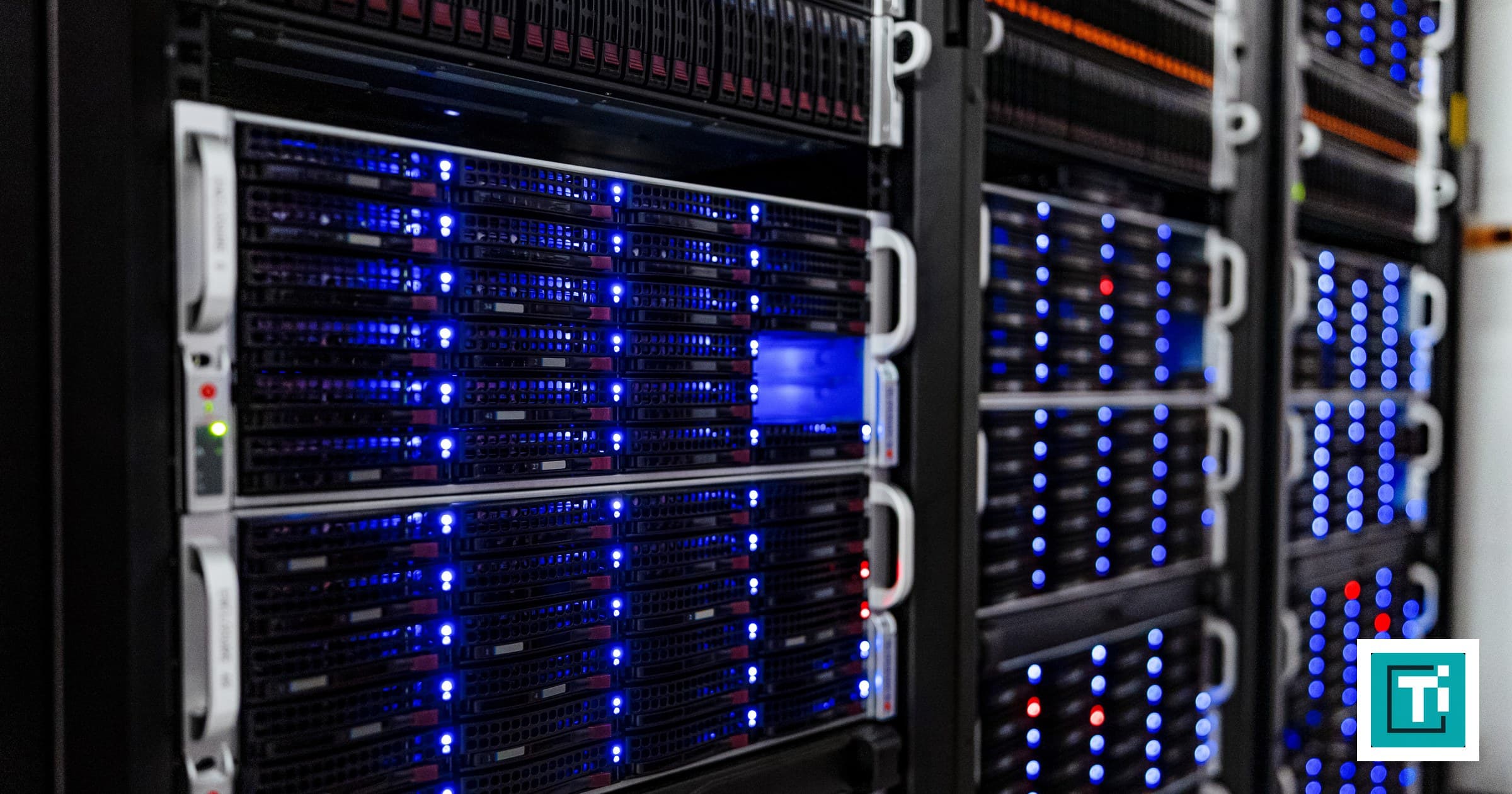
NOIRLab HQ server racks in Tucson, Arizona. Photo: NOIRLab/NSF/AURA/T. Slovinský, CC BY 4.0, via Wikimedia Commons. Cropped and TECHi mark added. Source: https://commons.wikimedia.org/wiki/File:NOIRLab_HQ_Server_Racks_(6V6A0404-CC).jpg
The useful question for 2027 is no longer whether artificial intelligence can create demand. It is which listed businesses can turn that demand into durable earnings without asking shareholders to fund an open-ended buildout. Five companies sit at different points in that test: Nvidia sells the dominant systems, Broadcom sells custom chips and networking, TSMC manufactures advanced silicon, Microsoft rents cloud capacity and sells enterprise software, and Amazon must make AWS growth outrun the cash it spends on infrastructure.
This is a guide to the businesses and the evidence to watch, not a prediction that all five share prices will rise. Their fiscal calendars differ, and “AI revenue” is not disclosed consistently. Nvidia's data-center line includes more than AI, Broadcom identifies an AI semiconductor line, and cloud revenue at Microsoft and Amazon contains non-AI workloads. Treating those figures as the same measurement would make an impressive-looking but false league table.
Key Takeaways
- The leadersNvidia, Broadcom, TSMC, Microsoft and Amazon each capture a different part of AI growth through 2027.
- Original findingBroadcom identifies AI chip sales directly; Nvidia and AMD report broader data-center lines. Their percentages are not the same measure.
- Cash testBroadcom reported $13.7 billion of quarterly free cash flow; Amazon reported a $7.6 billion trailing-12-month outflow. The periods and company scopes differ.
- What changes the viewThe next cloud earnings and 2027 margin trends will show whether capacity spending is producing durable returns.
The disclosure test behind the picks
The strongest original signal in the current filings is the gap between revenue that companies identify as AI-related and revenue that merely benefits from the theme. In its August results, Nvidia reported $89.0 billion of data-center sales on $96.2 billion of total quarterly revenue. That is 92.5% by division, calculated as 89.0 ÷ 96.2; it is not a pure AI-revenue percentage. Broadcom reported $16.7 billion of AI semiconductor revenue on $29.6 billion of total revenue. That is 56.4% of its quarter, calculated as 16.7 ÷ 29.6, and is a more specifically labeled AI sales figure. AMD reported $6.7 billion of data-center revenue on $11.5 billion of total sales, or about 58.3%; its data-center segment also includes server CPUs, so this ratio is another proxy, not AI accelerator sales.
Those three ratios measure different scopes, but they expose what an investor can and cannot check. A company with fast cloud growth may have a substantial AI opportunity while giving investors no separate AI revenue figure. Its cash-flow and margin trend then matters more than a marketing estimate. The five leaders below are selected for different ways to capture the 2027 opportunity, not because a single score makes them comparable.
| Company | Reported quarterly measure | Share of total sales | What it does not isolate |
|---|---|---|---|
| Nvidia | Data Center $89.0bn / total $96.2bn | 92.5% | Non-AI data-center sales |
| Broadcom | AI semiconductors $16.7bn / total $29.6bn | 56.4% | Other AI-related products |
| AMD | Data Center $6.7bn / total $11.5bn | About 58.3% | Server CPUs versus accelerators |
Five AI-stock leaders for growth through 2027
The order starts with the most observable AI sales and moves toward businesses whose 2027 case depends more heavily on turning infrastructure spending into cash. It is a ranking of evidence and business resilience, not a claim that the first name will post the highest stock return.
Nvidia: the cleanest direct revenue signal
Nvidia remains the benchmark for direct exposure. The same fiscal second-quarter release shows data-center revenue rising 117% from a year earlier and company gross margin of 75.0%. Management guided its next quarter to about $108 billion of sales, plus or minus 2%, without assuming data-center compute revenue from China. That guidance is a company forecast, not an observed shipment or a promise of 2027 growth.
For a buyer looking through 2027, the test is whether a larger installed base can keep orders and margins elevated as customers introduce their own accelerators. Nvidia sells a system of processors, interconnects, software and support, which helps explain why a customer cannot compare one chip price with another and call the switch simple. Yet a strong moat can still be a weak stock purchase if the market price assumes growth never normalizes. Watch the next reported data-center growth rate, gross margin, customer concentration and inventory rather than extrapolating the last 117% gain. Our Nvidia quote page carries the current market price separately from this dated business analysis.
Broadcom: AI orders with a visible cash engine
Broadcom offers a second route through custom accelerators and networking. Its fiscal third-quarter report identifies $16.7 billion in AI semiconductor sales, up 221% year over year, while the whole company produced $13.7 billion of free cash flow on $29.6 billion of revenue. The latter is 46.3% of reported revenue, calculated as 13.7 ÷ 29.6. It is a quarter-specific company-defined free-cash-flow measure, not a forecast of the same margin in 2027.
That combination makes Broadcom compelling when the question is whether infrastructure demand can turn into cash now. The counterargument is concentration: large custom-chip programs can be lumpy, and a powerful customer can change a design cycle. A useful 2027 check is whether AI semiconductor growth remains strong after the current ramp while consolidated free cash flow holds up. If sales rise but cash conversion shrinks, the thesis changes. Broadcom's stock page gives a separate, current valuation check.
TSMC: the manufacturer across rival chip designs
TSMC is less a wager on one accelerator brand than on the manufacturing and packaging capacity needed by several designers. Its October 15 third-quarter release reports NT$1,494.24 billion of revenue, up 50.9% from a year earlier, with a 66.4% gross margin. The currency matters: these figures are in New Taiwan dollars and should not be placed next to U.S.-dollar chip sales as if they were comparable. Its earnings-call transcript says third-quarter capital expenditure was US$13.8 billion.
The appeal is that a customer shift from one chip designer to another can leave the foundry demand intact. The cost is that expansion needs immense capital and new overseas plants carry different economics. Taiwan-related geopolitical risk also belongs in any account of this stock. By 2027, compare advanced-node demand, packaging availability, capital spending and gross margin. A volume increase that comes with persistent margin dilution is a different outcome from profitable capacity expansion. The TSMC quote page is the place for live price and valuation.
Microsoft: distribution must pay for compute
Microsoft's edge is distribution. In its June-quarter results, the company said Azure revenue exceeded $100 billion for fiscal 2026 and Microsoft 365 Copilot passed 30 million paid seats. These are useful adoption markers, but neither is a standalone AI profit number: Azure includes conventional cloud workloads, while a paid seat does not reveal margin after model-serving costs. Microsoft also reported $90.0 billion of quarterly company revenue and $40.6 billion of operating income.
The cash question is whether enterprise demand increases faster than the depreciation, power and model costs of serving it. Microsoft's earnings call reported Microsoft Cloud gross margin of 65%, lower year over year in part because of AI infrastructure investment and product use. This makes margin a more revealing 2027 checkpoint than a product-launch count. The next fiscal first-quarter earnings release is scheduled for October 28, so this section should be revisited after management publishes new numbers. The Microsoft stock page carries the market quote.
Amazon: AWS growth versus a negative cash-flow reading
Amazon presents the clearest capital-discipline test among the hyperscalers. Its second-quarter results show AWS sales up 37% to $42.2 billion, the fastest growth in 18 quarters, and AWS operating income of $16.6 billion. But the same release reports trailing-12-month free cash flow of negative $7.6 billion, citing a large increase in property and equipment purchases. Those are different periods and measures: one strong AWS quarter does not erase the trailing cash outflow.
Amazon is financing capacity for more than AI, so calling all capital expenditure an AI cost would overstate the evidence. The practical 2027 question is whether AWS revenue and operating profit continue rising while group free cash flow recovers. If not, high demand may still be a poor near-term equity outcome. Amazon's October 29 earnings call is on its investor calendar; that report will be the next place to check the trajectory. The Amazon quote page contains the live price, which is deliberately separate from this guide.
Seven names that require a sharper condition
The previous TECHi ranking also included seven companies that deserve attention. They remain part of this page because they capture different parts of the AI economy, but a growth watchlist is more honest than presenting every one as equally proven. Alphabet's second-quarter filing reported Google Cloud revenue of $24.8 billion, up 82%. Cloud is not identical to AI revenue, and its next earnings will show whether that acceleration persists alongside AI infrastructure spending. Meta's October 21 report says it expects 2026 capital expenditure of $135 billion to $145 billion. Meta argues AI already helps advertising; investors still need to watch whether incremental ad revenue can support that scale of investment.
AMD has the most direct challenger story in accelerators, but its reported data-center line combines more than GPUs. The August results show the segment more than doubling year over year; the next test is whether new accelerator deployments add profitable volume rather than simply a wider product range. Oracle's September release reports $7.4 billion of quarterly cloud-infrastructure revenue, up 121%, and $664 billion of remaining performance obligations. RPO is contracted future performance under accounting rules, not cash collected or realized profit; Oracle also disclosed a $20 billion equity raise. Delivery and financing therefore matter as much as headline bookings.
Palantir's second-quarter report showed $1.935 billion of revenue, up 93%, and $1.216 billion of cash from operations. Its growth is real in that period, but a software stock with a high expectation bar must repeat it. Arista reported $3.036 billion of second-quarter revenue, up 37.7%, as it sold networking for data and AI centers; the question is how much demand depends on a small group of cloud buyers. Marvell reported $2.739 billion of fiscal second-quarter revenue, up 37%, with data-center growth of 46%. Custom-chip and interconnect wins need to repeat across design cycles before a single strong quarter becomes a durable 2027 forecast.
How to use this ranking without mistaking it for a price target
The five leaders are ranked by how clearly an investor can trace current demand into revenue, cash and a 2027 checkpoint, not by projected share-price return. Nvidia has the cleanest near-term sales exposure but the highest dependence on continued compute spending. Broadcom pairs specific AI sales disclosure with cash generation. TSMC participates across rival chip designs but bears fabrication and geopolitical risks. Microsoft has enterprise distribution and a margin test. Amazon has accelerating AWS sales and the starkest free-cash-flow repair test. A lower rank here does not mean a weaker technology or a smaller possible share-price gain.
Before buying any of them, compare the current valuation with the latest results; a Sunday guide cannot know Monday's opening price. Separate a company's fiscal 2027 label from calendar 2027, and do not extend one quarter's percentage growth unchanged over multiple years. The next sequence of Microsoft, Alphabet, Amazon and AMD earnings will replace several inputs in this guide within days. If their cash and margins improve alongside capacity, the growth case strengthens. If spending rises faster than returns, the business may keep growing while the stock fails to reward investors.

Disclaimer
This article is for informational purposes only and does not constitute financial, investment, tax, or legal advice. Market data, tax rules, and prices can change after the article date. TECHi and its authors may hold positions in securities or digital assets mentioned. Always conduct your own research and consult a licensed financial, tax, or legal professional before making decisions.




Comments