



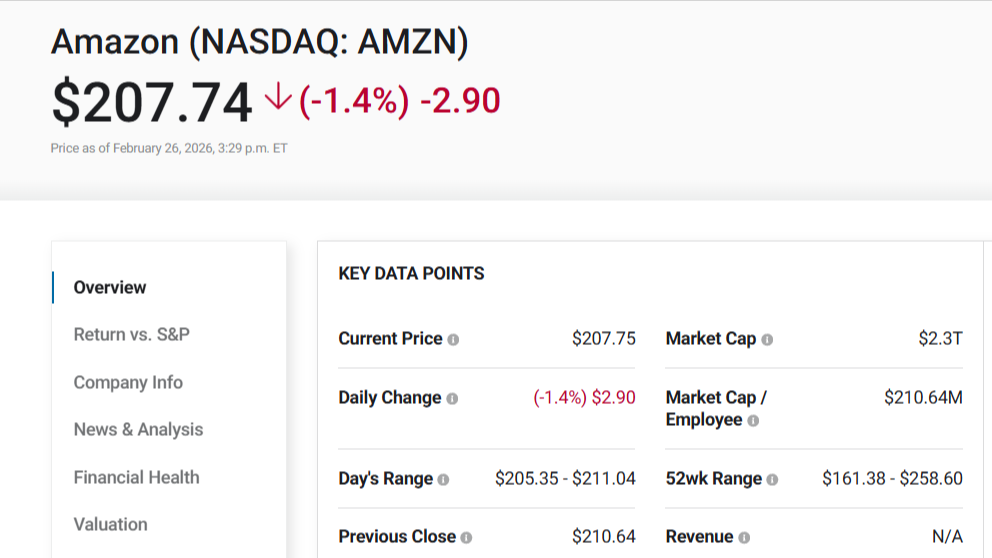
Amazon stock has cratered 18% in February alone, shedding $450 billion in market value amid the "SaaSpocalypse" hammering software giants. Shares closed at $207.74 on February 26, 2026, down 1.4% for the day and 11% year-to-date, as investors flee AI-fueled spending sprees.
SaaSpocalypse Hits Hard
Software stocks erased $285 billion in just 48 hours this year, with the broader sector down 20% year-to-date.
Culprits? Hyperscalers like Amazon are pouring billions into AI data centers, eclipsing SaaS growth. Amazon's Q4 2025 crushed expectations revenue hit $213.4 billion, up 14% year-over-year, fueled by resilient e-commerce and AWS surging 24% to $35.6 billion, its fastest pace in three years.
Amazon's stock price fell more than 7% in early trading on the 6th after the company simultaneously increased its capital expenditure forecast for this year to $200 billion, 33% higher than Wall Street's expectations. This raised concerns that significant artificial intelligence (AI) spending would reduce profits.
Cash Crunch Fuels Panic
Free cash flow tells the real story: trailing-12-month figure plunged 71% from $38.2 billion in 2024 to $11.2 billion by end-2025, as AI builds devoured operating cash. Revenue grew 12% to $717 billion last year, EPS up 30%, but capex ate gains, squeezing margins.
AWS posted $35.6 billion in Q4 2025 revenue, up 24% year-over-year, its fastest growth in 13 quarters, with an annualized run rate of $142 billion.
CEO Andy Jassystated said
"We are monetizing capacity as fast as we can install it,"adding that the investment is "predominantly in AWS, because we have very high demand."
Hidden AI Power Play
Amazon's $8 billion bet on Anthropic shines bright; its stake now tops $60.6 billion, powering AWS integrations like Bedrock and custom chips. Short-term cash pain persists, but AWS reacceleration and Anthropic's edge position it for explosive returns in agentic AI and robotics by 2027.
Disclaimer
This article is for informational purposes only and does not constitute financial, investment, tax, or legal advice. Market data, tax rules, and prices can change after the article date. TECHi and its authors may hold positions in securities or digital assets mentioned. Always conduct your own research and consult a licensed financial, tax, or legal professional before making decisions.
About the Author

Warisha Rashid covers AI stocks and crypto markets for TECHi. Recent work explains what changed when Worldcoin cut its WLD token unlock, how AMD's rack-scale Helios design fits an asset-light strategy, and how Nvidia, Alphabet, Palantir, AMD and Broadcom compare as AI businesses.


Comments