




The headline that crossed on June 19 was the kind that moves a stock: US officials suspect China may have gotten its hands on ASML’s most advanced chipmaking machine. For a company whose entire worth rests on controlling the one tool the modern world cannot make leading-edge chips without, an accusation that its crown jewel leaked into China is close to an existential charge. ASML’s response was unusually flat: it has never shipped an EUV lithography machine to China — not one — nor any component built specifically for one, and it knows where every machine it has ever made is, because they phone home.
Strip away the alarm and what actually happened is narrower than the headline. US Commerce Secretary Howard Lutnick told ASML executives, in a meeting earlier this year, that he is concerned an EUV machine or related gear reached China in breach of export controls — and, by the reporting, officials cited evidence they then declined to produce. It is an expressed concern, not a formal investigation, not a new rule, and not proof of anything. But it landed on the rawest nerve in the entire AI supply chain, and it is worth understanding why an unproven allegation can still matter to a $744 billion stock.
- The claimUS Commerce Secretary Lutnick told ASML he suspects an advanced EUV machine or related gear reached China — citing evidence officials would not produce.
- The denialASML says it has never shipped an EUV machine or EUV-specific component to China, and that none of its machines are there.
- What it is notIt is an expressed concern, not a formal probe, a new export rule, or a China retaliation. The allegation is contested and unproven.
- Why it mattersASML is the ~100% EUV monopoly — the chip world’s chokepoint — so anything touching its China status is a market event.
- The real storyChina has already fallen from ~41% of ASML revenue in 2024 to a guided ~20% in 2026; the overhang is the slow tightening, not this claim.
What was actually alleged — and ASML’s flat denial
The substance, as reported on June 19, is this: in a meeting with ASML’s leadership earlier in 2026, Lutnick said US officials had evidence the company was not acting in good faith on export controls, including the export to China of specialty gear used to transport EUV machines and their components. When pressed, officials reportedly declined to share the evidence, citing its sensitivity, and would not confirm that an actual EUV system had been found in China. In other words, the accusation was made; the proof was not produced.
ASML’s rebuttal was categorical. The company said it "has never shipped an EUV machine to China nor have we shipped to China any component, module or equipment specially designed to be used in an EUV machine," and that it has consistently adjusted its business to every change in export rules. It went further, pointing to an internal accounting of every EUV system it has ever built — hundreds in operation worldwide, a couple dozen decommissioned, and none in China. The denial is more credible than most corporate denials because of how the machines work: an EUV scanner is a building-sized system that communicates continuously with ASML and cannot be installed, moved, or kept running without the company’s own engineers. By ASML’s account, an EUV machine operating undetected in China is not just unlikely — it is close to physically impossible.
The suspicion does not come from nowhere. US officials have spent two years worried about restricted chip equipment being diverted into China through third countries, and the specific concern here was reportedly not a smuggled scanner but the specialized rigging used to move and install one — hardware that, on its own, would be an odd thing for China to acquire absent a machine to use it on. ASML’s answer is that the inference does not hold: the transport gear is not the scanner, and the scanner, the only thing that ultimately matters, is accounted for. Until the government produces the evidence it has so far kept to itself, the public is left with a serious accusation on one side and a categorical denial on the other, and very little in between.
Why an unproven claim still moves the stock
The reason a contested allegation can shake ASML is that there is no second ASML. It is the only company on earth that makes EUV lithography machines, and it holds something close to the entire market for the high-end equipment used to pattern advanced chips. Every processor below roughly seven nanometers — every advanced AI accelerator — is made with its machines, and EUV is increasingly required for the high-bandwidth memory feeding those accelerators as well. Remove ASML and the leading edge of the chip industry simply stops. That centrality is why ASML is worth three-quarters of a trillion dollars, and it is exactly why anything touching its relationship with China, or its standing with US regulators, becomes a market event rather than a footnote.
Which is the real point buried under the scary headline. This particular machine is almost certainly noise — a claim without public evidence, flatly denied, against a backdrop where the accused tool can be tracked to the meter. The durable story is the one the headline gestures at: ASML sits at the center of a geopolitical fight it cannot exit, and its China business has been shrinking under that pressure for two years. The question worth asking is not whether one EUV machine slipped through. It is how much further the China business has to fall.
China is already a shrinking slice

For all the drama, ASML has spent two years engineering its way to a smaller China. The country fell from about 41% of revenue in 2024 to roughly 33% in 2025, and management has guided China toward just ~20% of revenue in 2026. The 2024 peak was itself an artifact — Chinese fabs front-loaded orders for older, still-permitted machines ahead of tightening rules, inflating the mix. In the first quarter of 2026, China was down to 19% of system sales while South Korea surged to 45%, pulled by the memory build-out. The de-risking, in other words, is well underway and largely planned. A company that has already cut its China exposure roughly in half is not one that gets blindsided by the next restriction — it has been pricing that future in for some time.
The export-control machine, in brief
It helps to see how layered the regime already is. EUV — the top tier — has been off-limits to China since 2019, when the Dutch government quietly declined to renew ASML’s export license; not a single EUV machine has ever gone. The more advanced DUV immersion systems, a step down, were restricted starting in 2023 under parallel Dutch and US rules, and by 2024 even the servicing of advanced tools already installed in China required licenses for spare parts and software updates. Only mature, older-generation equipment still flows freely. The next escalation is already drafted: a proposed US bill, the MATCH Act, would ban advanced DUV exports outright and choke off servicing to named Chinese chipmakers, though it has not become law. A separate "affiliates" rule that would have widened the net is suspended until late 2026 under the current US–China trade truce. The trajectory is a one-way ratchet, paused now and then by diplomacy.
The read-through: it is not just ASML

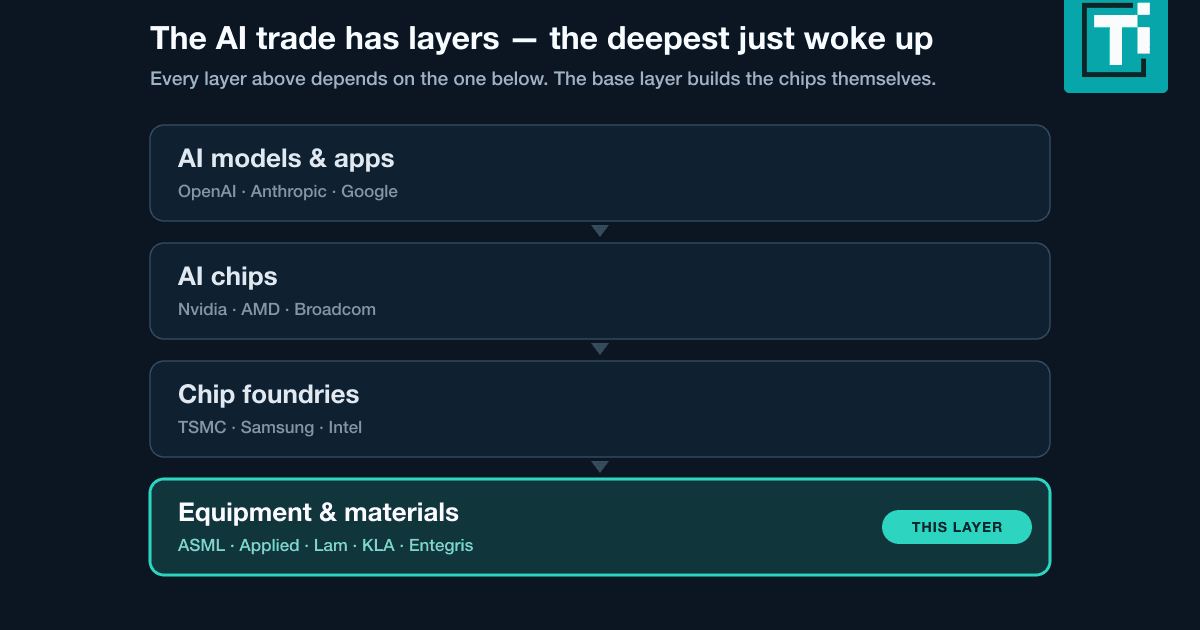
ASML is the headline, but the China question hangs over the whole equipment complex, which is why a single export story moved the entire group. By their most recent disclosures, China is roughly a fifth to a third of revenue at every major semicap name — about 20% for ASML, a similar share for Entegris, around 24% for KLA, near 30% for Applied Materials, and into the mid-30s for Lam Research. The recent rally across the semiconductor-equipment stocks was built on the AI build-out; the China overhang is the discount the market keeps applying against it. And the proposed MATCH Act would not simply hand ASML’s lost China share to US rivals — it names the American toolmakers too, making it a tax on the entire group rather than a reshuffling within it. One analyst at JPMorgan has estimated that a full US ban on advanced DUV sales and servicing could shave up to roughly 10% off ASML’s earnings; the read-through to its peers is similar in spirit if not in size.
The business underneath the noise
It is easy to lose the company in the geopolitics. ASML is, by any measure, in the strongest stretch of its history. It did €32.7 billion in revenue in 2025, up 16%, at a gross margin near 53% and €9.6 billion of net income. The first quarter of 2026 brought €8.8 billion in sales and a 53% gross margin, and management raised full-year guidance to €36–40 billion. One wrinkle for readers: ASML stopped reporting quarterly order bookings and backlog this year, so there is no fresh "orders beat" number to parse — the last backlog figure, near €39 billion at the end of 2025, is the standing one. The next growth leg is High-NA EUV, the next-generation machine that runs close to $400 million apiece, with Intel as the first production customer for its most advanced node.
The demand side is what justifies the multiple. Each new generation of AI chip needs more lithography, not less — more EUV layers per advanced logic die, and now EUV creeping into DRAM as memory makers chase the density AI servers require. High-NA, the next-generation system, sharpens resolution again and carries that ~$400 million sticker, which is why even a handful of orders move the needle. ASML’s own long-range plan calls for revenue between €44 billion and €60 billion by 2030 — a target that assumes the AI lithography wave runs for years and that growth in Taiwan, Korea and the United States more than replaces what China gives up. The China losses, in that framing, are a managed headwind, not a hole in the thesis.
The market has noticed all of it. ASML is up roughly 78% in 2026 and trades around 65 to 70 times trailing earnings — a rich multiple even for a monopoly, sustained by the belief that AI keeps the lithography order book full for years, a belief reinforced when the stock first pushed past a half-trillion-dollar valuation. As with the rest of this group, the rally has outrun the analysts: at about $1,930 the US shares sit above the average 12-month target near $1,720. The targets are catching up rather than flashing a warning, but the gap is a reminder that a lot of good news is already in the price — which is precisely why a geopolitical scare, even an unproven one, gets the reaction it does.
What to watch from here
The specific allegation will fade or harden quickly. These are the markers that actually matter:
- Evidence or escalation. If US officials produce proof or open a formal investigation, this stops being noise. Absent that, it stays a headline.
- The MATCH Act. Movement on the bill — a floor vote, a markup — is the real policy risk to the whole group, far more than any single machine.
- ASML’s Q2 results. The next report, expected in mid-July, and any change to the China guide or full-year outlook will say more than the rhetoric does.
- Servicing licenses. Decisions on whether ASML can keep maintaining advanced tools already in China are a quiet but real revenue lever.
- The semicap tape. Watch whether peers like Lam, Applied and KLA move with ASML on China headlines — that confirms the read-through is driving the group.
The cleanest way to hold this story is to separate the two things the headline blurs together. The accusation that China has an ASML EUV machine is contested, unproven, and — given how tightly the company tracks its install base — most likely wrong. The structural fact underneath it is real and unchanging: ASML is too important to chip-making to ever sit outside great-power politics, its China business is being deliberately shrunk, and its stock carries both the premium of a monopoly and the discount of a geopolitical hostage — and on any given week, the market decides which of the two is louder. For the live price and analyst targets as the next earnings approach, the ASML quote page carries the current numbers.
FAQ
Frequently asked questions
What is the new ASML China export scrutiny?
On June 19, 2026, Bloomberg reported that US Commerce Secretary Howard Lutnick told ASML executives he is concerned one of the company's top-tier EUV chipmaking machines, or related components, may have reached China in violation of export controls. ASML denied it, saying it has never shipped an EUV machine or EUV-specific component to China. It is an expressed concern, not a formal investigation or a new rule.
Has ASML ever sold EUV machines to China?
No. ASML has never shipped an extreme ultraviolet (EUV) lithography machine to China; the Dutch government has withheld an export license since 2019. ASML says all of its EUV machines worldwide are accounted for, with none in China, and that the machines cannot be relocated without ASML's involvement.
How much of ASML's revenue comes from China?
China fell from about 41% of ASML's revenue in 2024 to roughly 33% in 2025, and the company has guided China to around 20% of revenue in 2026 as export controls and the fading of an older-tool buying surge reduce the mix.
Why does ASML matter so much to the chip industry?
ASML is the only company in the world that makes EUV lithography machines, the tools required to manufacture the most advanced chips, and it holds roughly 90% or more of the high-end lithography market. That monopoly makes it the single most critical chokepoint in the global semiconductor supply chain.
Does the China news change ASML's outlook?
Not directly. No analyst had repriced ASML on the June 19 report as of publication, and the company maintained its 2026 revenue guidance of 36 to 40 billion euros. The larger risk is the slow tightening of export rules, such as the proposed MATCH Act, which one analyst estimates could cut ASML's earnings by up to roughly 10%.
Disclaimer
This article is for informational purposes only and does not constitute financial, investment, tax, or legal advice. Market data, tax rules, and prices can change after the article date. TECHi and its authors may hold positions in securities or digital assets mentioned. Always conduct your own research and consult a licensed financial, tax, or legal professional before making decisions.
About the Author
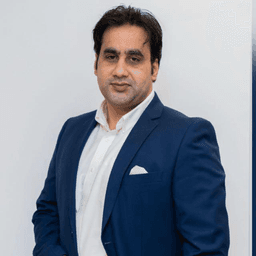
Umair Aslam is a finance executive who writes about public companies, AI infrastructure and semiconductor markets for TECHi. He completed INSEAD's Management Acceleration Leadership Program in executive education in 2025. Recent analysis covers ASML's High-NA EUV milestone, Eos Energy's backlog and margins, Situational Awareness's 13F filings and SanDisk's move into the S&P 100.

Comments