

More from the desk
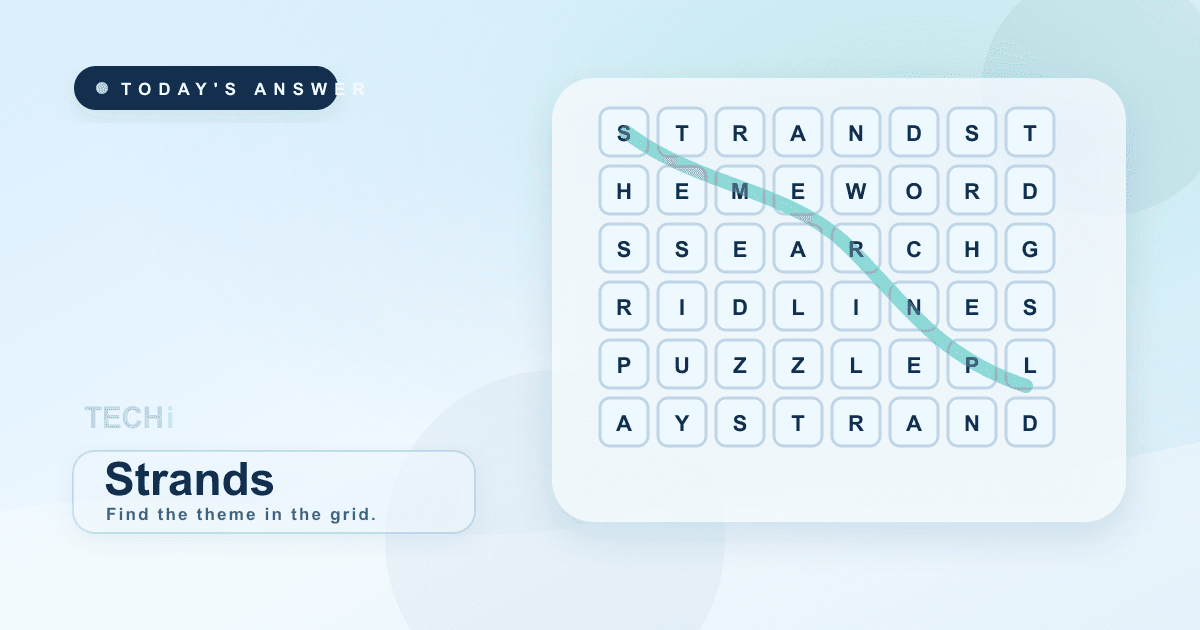
NYT Strands is the daily word-search-meets-theme puzzle from The New York Times. You get a grid of 48 letters — six columns wide and eight rows tall — and a themed clue at the top. Every letter belongs to exactly one answer, and one special answer, the spangram, ties the whole theme together. For today's theme, hints, and the full solution, see the Strands hints and answer page; this guide covers the rules and how to solve faster.
What is Strands?
Strands joined the NYT Games lineup in 2024. Unlike a normal word search, there are no random filler letters: every one of the 48 letters is used in exactly one theme word, so the grid is fully solved only when you've found them all. Words can bend in any direction — across, down, diagonally, and around corners — by dragging or tapping connected letters.
The pieces you're looking for
- Theme words — the everyday answers that all relate to the day's clue. They light up blue when correct.
- The spangram — one special answer that touches two opposite sides of the grid (left-to-right or top-to-bottom) and names or sums up the theme. It lights up yellow, and finding it early often cracks the whole board.
- Hints — every time you find three valid words that aren't part of the theme, you earn a hint that highlights the letters of one theme word.
Strategy that solves the board faster
- Read the theme literally, then laterally. The clue is your biggest edge over a plain word search. Brainstorm words that fit it before you even look at the grid.
- Hunt the spangram first. Because it spans two opposite sides, scan the edges for a long answer. Landing it tells you the theme's exact angle and removes a big chunk of letters.
- Mine for non-theme words to bank hints. If you're stuck, deliberately find ordinary words to trigger a hint — there's no penalty for guessing in Strands, only for giving up.
- Work the corners carefully. Corner letters have the fewest connecting neighbors, so they're usually the start or end of a word — a useful constraint once most of the grid is solved.
- Let solved words shrink the field. Every answer you lock removes its letters from play, so the remaining options get easier with each find.
A few quick facts
Strands is free on the NYT site and app, refreshes daily, and has no guess limit — wrong attempts don't cost you anything, which is why it rewards patient trial and error. The spangram is the single most useful answer to find, so when you're stuck, look for the long one that reaches across the grid.
For today's theme, the spangram, and every answer laid out, visit the Strands hints and answer page, updated daily.
FAQ
What is the spangram in Strands?
The spangram is one special answer that touches two opposite sides of the grid (left-to-right or top-to-bottom) and sums up the day's theme. It's highlighted in yellow, and finding it early often reveals the theme's exact angle.
How big is the Strands grid?
Strands uses a grid of 48 letters — six columns wide and eight rows tall. Every letter is part of exactly one theme word, with no filler letters.
How do hints work in Strands?
Each time you find three valid words that aren't part of the theme, you earn a hint that highlights the letters of one theme word. There's no penalty for those non-theme guesses.
Is there a guess limit in Strands?
No. Strands has no guess limit and no penalty for wrong attempts, so you can experiment freely until the whole board is solved.
Is Strands free?
Yes. Strands is free to play on The New York Times website and the NYT Games app.
What time does Strands reset?
A new Strands puzzle unlocks at midnight your local time.
Get tomorrow's hints in your inbox
Daily Strands hints, answers, and trivia — sent fresh at midnight ET.