
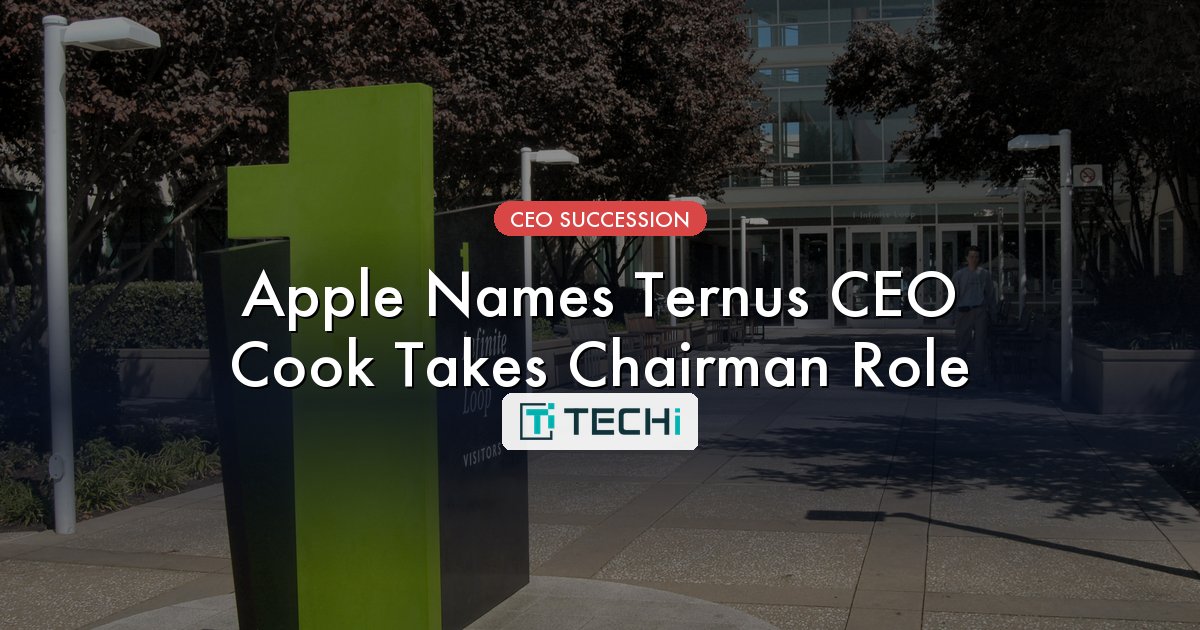
- The AnnouncementApple announced April 20, 2026 that John Ternus, Senior Vice President of Hardware Engineering, will succeed Tim Cook as CEO effective September 1, 2026. Cook becomes Executive Chairman.
- Board VoteUnanimous. Arthur Levinson, non-executive chairman since 2011, becomes lead independent director on September 1. Ternus joins the board the same day.
- Ternus ProfileAge 50. Penn-educated mechanical engineer. Joined Apple 2001. Led iPad, AirPods, Mac before adding iPhone in 2020. SVP Hardware Engineering since 2021. Added industrial design oversight January 2026.
- Market ReactionAAPL closed Friday at $270.23. Shares fell roughly 1% in Monday after-hours trading. The muted reaction reflects a succession that was already fully priced in.
- Strategic SignalCook was an operator; Ternus is a hardware engineer. The board's pick tells the market Apple's next decade will be defined by product reinvention — Vision Pro, iPhone Fold, M-series mobile, industrial design — not by supply-chain discipline.
Apple (NASDAQ: AAPL) announced on Monday, April 20, 2026 that John Ternus, the company's Senior Vice President of Hardware Engineering, will succeed Tim Cook as Chief Executive Officer effective September 1, 2026. Cook will transition to Executive Chairman. The succession plan was unanimously approved by Apple's board of directors, with Cook continuing in the CEO role through the summer while working alongside Ternus on the handover. Arthur Levinson, who has served as non-executive chairman for fifteen years, will step into the lead independent director role on the same September 1 date. Shares fell roughly 1% in after-hours trading following the announcement, a muted reaction that reflects how well-telegraphed this succession has been. The real signal is not that Ternus was named — that was the market's base case for over a year. It is that the board chose a hardware engineer to run the most valuable consumer technology company in history, rather than an operator or a services executive. That tells you what Apple thinks the next decade looks like.
Who Is John Ternus
Ternus is a 50-year-old mechanical engineer who has been inside Apple for twenty-five years. He joined the company in 2001 as a member of the product design team, initially working on the Apple Cinema Display. He studied mechanical engineering at the University of Pennsylvania, graduating in 1997, and began his career at Virtual Research Systems building early virtual-reality head-mounted displays, a detail worth holding onto given that the Apple Leadership page now lists Vision Pro among his engineering remits.
The promotion ladder inside Apple is the clean tell for where Ternus ended up. He became Vice President of Hardware Engineering in 2013, working under Dan Riccio across AirPods, Mac, and iPad programs. In 2020, iPhone hardware was added to his portfolio. In 2021, he was promoted to Senior Vice President of Hardware Engineering, replacing Riccio as Apple's top hardware executive. By 2022, Apple Watch hardware had moved under his leadership as well. A January 2026 reorganisation handed him oversight of industrial design — the storied department once led by Jony Ive, making him the most powerful engineering executive Apple has had since the Steve Jobs era.
Ternus has also been Apple's most visible keynote presenter outside of Cook in recent years. He introduced the 2018 iPad Pros, the redesigned 2019 Mac Pro, the M-series MacBook Pro refreshes, and most of Apple Vision Pro's launch arc. That public-facing track record matters because running Apple is not only an engineering job. It is a communicating-vision job, and the board clearly decided Ternus could do both.
Tim Cook's Exit: Fifteen Years and Roughly Elevenfold Growth
Cook took over from Steve Jobs in August 2011 after Jobs stepped down for health reasons. Over the fifteen years that followed, Apple went from a roughly $350 billion market cap to the $4 trillion threshold it first crossed on October 28, 2025. That is a roughly elevenfold increase in market value, one of the largest absolute wealth-creation arcs in corporate history.
Cook's years are most often remembered for three structural shifts. The first was the conversion of Apple from a hardware cycle company into a services compounder. App Store, iCloud, Apple Music, AppleCare, and Apple Pay collectively producing gross margins above 70% and roughly 26% of total revenue at current run rates. The second was the full vertical integration of silicon through Apple Silicon, beginning with the M1 transition in 2020 and extending through the current M-series Macs and A-series iPhones. The third was the return of capital programme: Apple has repurchased roughly 43% of its shares since 2013, a buyback arc that shaped the compounding for long-term holders more than any individual product launch.
As Executive Chairman, Cook will keep a formal role in Apple's operations and will continue engaging with global policymakers, the regulatory-and-trade dimension of the CEO job that has defined much of his last four years. That matters in a year when Apple is still running up against a roughly $20 billion tariff exposure on China-assembled iPhones and when US-China trade policy continues to move on executive-order timelines.
Why a Hardware Engineer, Not an Operator
Cook himself was an operator, a supply-chain master who built the logistics machine that made the iPhone scale. Picking Ternus, a hardware engineer rather than a COO or CFO, is a strategic statement from the board. It says Apple's next decade will be defined by product reinvention, not by the supply-chain discipline that defined the last decade.
The list of hardware programmes under Ternus's direct leadership reads like a capital-allocation map for the next five years: Apple Vision Pro and spatial computing, the iPhone Fold that leaked into 2027 roadmaps, the M-series Mac transition to on-device AI acceleration, Apple Watch health sensors, AirPods with spatial audio, and now industrial design. If the next decade at Apple is defined by integrated silicon, ambient computing, health hardware, and AR, the board has chosen the executive whose entire career maps to exactly that stack.
There is a second read. Picking an engineer also signals that Apple sees its long-run differentiation running through hardware defensibility rather than services optionality. Services can be replicated; custom silicon and industrial design cannot, at least not at Apple's scale. That framing matters for how analysts should value the stock through the transition.
What It Means for AAPL Stock
AAPL closed Friday at $270.23 and shed approximately 1% in after-hours trading on Monday's announcement. The muted reaction is important. Large CEO transitions historically move mega-cap stocks by 3% to 6% on the announcement session when the successor is a surprise. A 1% move tells the market the succession was priced in well before the announcement. Reports from January 2026 had already flagged Ternus as the heir apparent, and TechCrunch's desk coverage of the announcement noted the base case had been set for over a year.
The structural question for anyone buying AAPL today is whether the transition changes the multiple. At roughly 32 times trailing earnings and 28 times forward, Apple trades at a premium that historically rewarded management continuity. Ternus represents continuity (he is a 25-year Apple veteran), but the board has made a specific bet on reinvention velocity. If he delivers the next hardware platform on a credible timeline, the current multiple holds or expands. If product launches slip into 2028 or later, the multiple compresses quickly. That is the real risk the market is now pricing.
The Transition Mechanics
The operational timeline is clean. Cook remains CEO through the summer of 2026. Ternus joins the board of directors on September 1, 2026, the same day he formally takes the CEO title. Arthur Levinson, the Genentech veteran who has chaired Apple's board since 2011, shifts from non-executive chairman to lead independent director. Cook steps into Executive Chairman, a role that implies he remains active on strategy and external affairs rather than purely ceremonial.
That overlap of Cook and Ternus over the summer is the single most important execution variable. Leadership transitions where the outgoing CEO exits cleanly often work well; transitions where the outgoing CEO stays in a formal role can work brilliantly (Schwab, Berkshire Hathaway) or become quietly dysfunctional (Microsoft in the early Ballmer years). Apple's board has clearly bet on the former, because Cook and Ternus have already worked side by side for years. The hand-off is unlikely to break on interpersonal friction.
What Changes First for Apple
Three operational items move to the top of the agenda under a Ternus-led Apple. The first is Apple Intelligence and the Gemini-powered Siri layer. The integration is already in-flight, but a hardware-first CEO is more likely to push on-device AI acceleration as the differentiator versus cloud-dependent rivals. That is a bet Apple Silicon can keep pace with Nvidia's data-center roadmap for inference workloads at the edge. Readers tracking the broader NVIDIA stock infrastructure thesis should watch whether Apple's inference story positions silicon as an alternative platform rather than an add-on.
The second is hardware cadence. A Ternus-led Apple is more likely to ship the iPhone Fold earlier, push Vision Pro's second-generation timeline forward, and accelerate the M-series roadmap into mobile form factors. The third is industrial design. With the ex-Ive successor function now reporting up through Ternus, Apple's design language over the next two to three years is effectively a Ternus decision tree. That has not been true since Jobs.
One item that probably does not change in the near term: the services compounding story. The App Store economics, Apple Music, iCloud tier pricing, and Apple Pay integration are institutional products now, not executive priorities. They will continue growing on the current trajectory regardless of which engineer sits in the CEO office.
The Risk Watch
Three risks deserve to be named rather than buried. First, regulatory. Apple is still in active antitrust exposure in the US (App Store), the EU (Digital Markets Act), and several Asian jurisdictions. Cook's value through those fights was a calm, consensus-building negotiating posture honed over fifteen years of policy meetings. Ternus is an unknown in that forum. The Executive Chairman role partially bridges the gap, but only partially.
Second, operational. The supply chain Cook built is a machine. A hardware-first CEO tends to push products to market faster, which can stress that machine. Any early missed launch or quality incident would be read as a governance break, not a normal stumble. TECHi's coverage of Apple versus Broadcom on the dividend and AI analysis track walks through why Apple's silicon partner dynamics are more fragile than they look.
Third, geopolitical. The Strait of Hormuz crisis is live, tariffs remain unsettled, and Apple's Asia-manufacturing exposure is structural rather than cyclical. TECHi's earlier breakdown of how the Hormuz shutdown reprices tech stocks lays out the three transmission channels by which macro stress hits Apple's multiple. Under a new CEO, any one of those channels firing hard in 2026 would get blamed on the leadership transition regardless of whether the transition actually caused it.
The Long View
Succession at Apple has happened exactly twice in the modern era. Jobs to Cook in August 2011. Cook to Ternus in September 2026. Fifteen years between transitions. Each one redefines the company's centre of gravity: Jobs built the products, Cook scaled them, and Ternus now inherits a $4 trillion balance sheet, the most trusted consumer brand in technology, and the hardware engineering bench that will decide whether Apple's next platform arrives in 2028 or 2030.
The honest read is that the board picked a safe name for the medium term and a potentially brilliant name for the long term. Safe because Ternus is a continuity choice: twenty-five years at the company, already running the largest product segments, well-known to the entire executive team. Brilliant because if Apple Vision Pro and the iPhone Fold become the platform launches that define the back half of this decade, the CEO driving those launches will be the person who built the teams that designed them. The stock should behave accordingly.
For context on the valuation backdrop, TECHi's Apple stock pillar covers the price target, forecast, and full analysis framework that every long-term holder should work through.
Editorial note & methodology. Published on April 21, 2026 and reviewed by the TECHi editorial team before publication. Every financial figure here was cross-checked against primary sources at the time of writing (Apple investor relations page, SEC filings, CNBC desk coverage, TechCrunch live reporting). Analyst references reflect publicly-stated positioning of named research houses; price targets and ratings referenced are verified at the time of writing. We will update this coverage if Apple files an amended 8-K or if the CEO transition timeline changes. TECHi follows the TECHi editorial policy and fact-checks YMYL financial content before publication.
For broader AI-infrastructure context, see TECHi's GE Vernova and Vertiv AI data-center analysis.
FAQ
Frequently asked questions
Who is Apple's new CEO?
John Ternus, Apple's Senior Vice President of Hardware Engineering, was announced as the next CEO on Monday, April 20, 2026, effective September 1, 2026. Ternus is 50 years old and has been with Apple for twenty-five years. He leads the hardware teams behind iPhone, iPad, Mac, Apple Watch, AirPods, and Apple Vision Pro.
When does the CEO transition take effect?
September 1, 2026. Tim Cook will remain CEO through the summer of 2026 and work alongside Ternus on the handover. On September 1, Ternus formally takes the CEO role and joins Apple's board of directors. Cook transitions to Executive Chairman, and Arthur Levinson, the current non-executive chairman, becomes lead independent director.
What will Tim Cook do as Executive Chairman?
Cook will remain active on company operations, global policymaker engagement, and external affairs. Executive Chairman is not a purely ceremonial role. Cook has served as CEO since August 2011, when he succeeded Steve Jobs, and the board has clearly preserved his involvement in strategy and regulatory matters given his fourteen years of accumulated relationships.
How did AAPL stock react to the announcement?
Apple shares fell roughly 1% in after-hours trading on Monday April 20, 2026, following the announcement. The muted response reflects how well-telegraphed the succession was — reports dating back to January 2026 had already flagged Ternus as the heir apparent. Large CEO transitions historically move mega-cap stocks by 3% to 6% when the successor is a surprise; the 1% move indicates the announcement was priced in.
What is John Ternus's background?
Ternus holds a B.S. in mechanical engineering from the University of Pennsylvania (1997), where he competed on the men's swimming team. He began his career at Virtual Research Systems building VR head-mounted displays. He joined Apple in 2001 on the product design team, became Vice President of Hardware Engineering in 2013, took over iPhone hardware in 2020, and was promoted to Senior Vice President in 2021. A January 2026 reorganisation gave him oversight of industrial design.
Why did Apple pick an engineer rather than an operator?
Cook himself was a supply-chain operator; picking Ternus — a hardware engineer — is a strategic statement that Apple's next decade will be defined by product reinvention rather than operational discipline. Ternus has led Apple Vision Pro, the M-series Mac silicon transition, the iPhone hardware line, and, as of January 2026, industrial design. That portfolio maps directly to the hardware platforms expected to carry Apple through 2028 and beyond.

Disclaimer
This article is for informational purposes only and does not constitute financial, investment, tax, or legal advice. Market data, tax rules, and prices can change after the article date. TECHi and its authors may hold positions in securities or digital assets mentioned. Always conduct your own research and consult a licensed financial, tax, or legal professional before making decisions.
About the Author

Jazib Zaman founded TECHi in 2010 and is chief executive of its publisher, TechAbout LLC. He is a former member of the Forbes Technology Council. His TECHi writing covers AI infrastructure, semiconductor businesses and the financial tradeoffs of adopting new technology. His published work includes company earnings and valuations, AI software costs, and the effect of technology investment on public markets.


Comments