




AppLovin is a useful stress test for TECHi's AI stock model because it refuses to fit the easy categories. It is not a chipmaker, not a cloud landlord, and not a software company selling seats to CIOs. Its AI shows up in a messier place: ad auctions, bid optimization, app discovery, and the conversion math that decides whether a mobile impression is worth buying. That is exactly why APP still ranks near the top of TECHi's stock model. The model is not rewarding the phrase "AI advertising" by itself. It is rewarding a business where the AI claim has already shown up in revenue growth, margin structure, and cash generation. The uncomfortable part is that the market has noticed the same thing.
Why TECHi Still Ranks APP So Highly
On TECHi's /markets/stocks/ hub, AppLovin is prominent in the AI applications and software-data cohort. The reason is not a single headline or a one-day price move. The one-year model favors quality trend, forward growth, earnings revision strength, and market sponsorship, then subtracts for valuation pressure. APP scores unusually well on the first three and gets penalized on the last one.
That mix matters. Plenty of AI stocks screen well on narrative and poorly on proof. APP is almost the reverse: the story can sound abstract, but the operating numbers are concrete. The model likes it because AppLovin's advertising platform has become a high-margin growth engine, not because the stock is trading at a bargain-bin multiple.
The Quality Signal Is Not Subtle
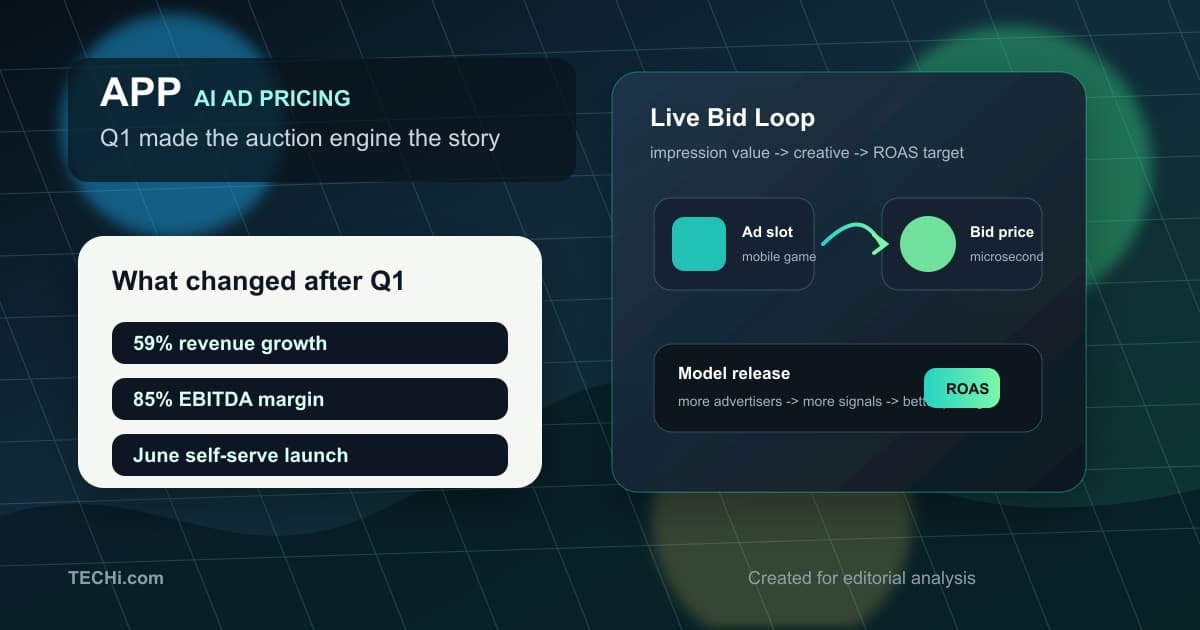
AppLovin reported Q1 2026 results on May 6 and filed the same release with the SEC for the quarter ended March 31, 2026. The numbers would stand out in almost any software screen: revenue of $1.84 billion, up 59% from a year earlier; net income of $1.21 billion, a 65% net margin; adjusted EBITDA of $1.56 billion, up 66%; and free cash flow of roughly $1.3 billion, up 56%. Diluted earnings per share came in at $3.56, and the company spent $1.0 billion repurchasing 2.2 million shares during the quarter.
One housekeeping note matters for anyone comparing against older coverage. AppLovin closed the sale of its mobile gaming studios to Tripledot on June 30, 2025, so the year-ago base is restated to $1.16 billion of continuing-operations revenue and the release no longer splits advertising from apps. What is left is the advertising platform, and the 59% above is the platform's own growth rate, not a blend flattered by a disposal.
The margin line is the tell. A company can grow quickly by buying volume, discounting aggressively, or leaning on a hot market. AppLovin's Q1 adjusted EBITDA margin was 85%, the highest it has reported, and management guided Q2 revenue of $1.915 billion to $1.945 billion with adjusted EBITDA of $1.615 billion to $1.645 billion, an 84% to 85% margin. That implies a business where incremental revenue falls through at a rate most AI software companies would like to have.
One caveat from the earnings call belongs next to the cash number. CFO Matt Stumpf said Q1 free cash flow was lifted by the timing of interest and tax payments, and that conversion should settle near 75% of adjusted EBITDA for 2026 as cash taxes land in the second and third quarters. The Q1 figure is real; it is not the run rate.
That is the TECHi-native reason APP sits so high. The model is looking for AI companies where the product loop is already financial. In AppLovin's case, better ad matching should raise return on ad spend, which should attract more advertiser demand, which gives the model more auction data, which can improve targeting again. When that loop works, the income statement notices.
The next test of that loop is scheduled for June, when AppLovin plans to open its self-serve ads platform to advertisers who do not have an existing direct relationship with the company. Management also said April was its largest month ever for consumer-vertical advertiser spend. Those are company statements, not audited figures, and the model does not score them until they reach a reported quarter.
The Valuation Brake Is Real Too
This is where the quote page becomes more cautious than the stock hub. APP closed June 2, 2026 at $605.63, down 1.3% on the day, after a run from $468.83 on the day of the Q1 release. With 336 million shares outstanding at the end of the quarter, that is a market value of roughly $204 billion. The APP quote page showed a consensus target of $647.85 across 34 analysts, about 7% above that close. That is not the setup of a forgotten compounder.
The quote page's Decision Lens reads Neutral watch, with a 58/100 score, while the forward model is Positive but selective. That split is not a contradiction. It is the product doing what it should do: the stock hub highlights APP as one of the cleaner AI quality stories, while the quote page reminds readers that high quality and good entry price are different questions. That same selectivity shows up on TECHi's APP forecast page, where quality and growth leads are high but valuation pressure keeps the setup from reading like a simple green light.
The free-cash-flow yield sharpens the point. Add up the last four reported quarters, $768 million in Q2 2025, $1.05 billion in Q3, $1.31 billion in Q4, and about $1.29 billion in Q1 2026, and trailing free cash flow is roughly $4.4 billion, a yield of about 2.2% on a $204 billion market value. That is the market saying investors are paying for persistence: sustained platform growth, durable pricing power, and a margin profile that does not fade as AppLovin pushes into broader advertiser categories.
What Could Break the Ranking
The cleanest risk is that AppLovin's AI advantage proves narrower than the current growth rate suggests. If advertisers see weaker returns, if the self-serve opening brings volume but not quality, or if larger ad platforms squeeze the same performance gap, the quality score can fall quickly. This is still an advertising business, and advertising businesses can look strongest near the top of a cycle.
Platform and policy risk also deserve a line. AppLovin depends on mobile ecosystems, signal quality, and advertiser confidence. Changes in privacy rules, app-store economics, or auction transparency can move the economics even when the model itself keeps improving. A high stock-model rank should not make those risks disappear; it should make them more specific.
What Would Make the Ranking More Durable
For APP to keep its place near the top, the next few quarters need to show that Q1 was not the peak print. Watch revenue growth against the Q2 guide, adjusted EBITDA margin, free cash flow conversion once the tax timing normalizes, and evidence that spend from advertisers outside gaming keeps compounding after the June opening. The most constructive version of the story is not simply that AppLovin has AI. It is that AppLovin's AI system can keep raising advertiser outcomes without requiring an equal rise in operating cost.
If that remains true, the premium multiple has a defense. If growth slows while the valuation stays stretched, the stock can still be a strong business and a difficult trade.
How TECHi Reads APP Now
APP deserves its high TECHi model rank because it has one of the cleaner financial translations of AI in public markets: rapid platform growth, unusually high margins, and cash generation that already looks mature. It also deserves the quote page's caution because the market is pricing in a long runway.
That is the right way to read the ranking. APP is not near the top because it is an easy buy. It is near the top because the business quality is hard to ignore. From here, the burden shifts to execution: every quarter has to defend the premium the model is flagging.
FAQ
Frequently asked questions
Why does AppLovin rank near the top of TECHi's AI stock model?
APP ranks high because TECHi's model gives strong credit to quality, growth, revision strength, and cash-flow conversion. AppLovin's Q1 2026 advertising revenue rose 71% year over year, and the company produced $920 million of free cash flow.
Is the TECHi AI stock model a buy recommendation?
No. The model is a research screen, not personalized investment advice. A high rank means the stock scores well on TECHi factors; investors still need to assess valuation, risk, position sizing, and timing.
What AppLovin metric matters most now?
Advertising revenue growth and adjusted EBITDA conversion matter most. They show whether AppLovin can keep turning AI-driven ad matching into revenue and cash flow rather than just headline growth.
Why is valuation a risk for APP stock?
TECHi quote data after the June 2, 2026 close showed APP at $597.08, a $205.96 billion market cap, and only 8.5% consensus target upside. At that level, the market is already pricing in durable growth and high margins.
Disclaimer
This article is for informational purposes only and does not constitute financial, investment, tax, or legal advice. Market data, tax rules, and prices can change after the article date. TECHi and its authors may hold positions in securities or digital assets mentioned. Always conduct your own research and consult a licensed financial, tax, or legal professional before making decisions.
About the Author

Umair Aslam is a finance executive who writes about public companies, AI infrastructure and semiconductor markets for TECHi. He completed INSEAD's Management Acceleration Leadership Program in executive education in 2025. Recent analysis covers ASML's High-NA EUV milestone, Eos Energy's backlog and margins, Situational Awareness's 13F filings and SanDisk's move into the S&P 100.

Comments